- 29. See also: De Clercq, E., Haas, M. (2015). Laat de nacht nooit eindigen; van discothèque tot rave [Let the night never end; from discothèque to rave]. Uitgeverij Bas Lubberhuizen.↩
- 30. See also: RTL Nieuws (2017, 27 July - Updated: 28 July 2017). Hundreds of libraries have closed in recent years due to budget cuts. RTL Nieuws.↩
- 31. Serrà, J., Corral, Á., Boguñá, M. et al. (2012). Measuring the Evolution of Contemporary Western Popular Music. Sci Rep 2, 521.↩
- 32. Alberto Posso (August 2016). Internet Usage and Educational Outcomes Among 15-Year-Old Australian Students. International Journal of Communication (10), 3851-3876.↩
- 33. Shriver, L. (2017, 19 February). We need to talk about sense and sensitivity. The Guardian.↩
- 34. Zhao, A. W. (2019). Blood Heir. First edition. Delacorte Press.↩
- 35. Should further reflection be warranted, Mondrian’s life story stands as a compelling antithesis to cultural trivialisation. While Mondrian was captivated by the vibrant rhythms of jazz and the Boogie-woogie piano style, he devoted his artistic career in Paris and the United States to the pursuit of a perfect equilibrium between planes, lines, and colours. It is, perhaps, fitting that his final, unfinished masterpiece was titled Victory Boogie Woogie; after all, he had moved to New York expressly to infuse his work with greater rhythm. For those wishing to explore these lines and planes in greater depth: The Mondrian House.↩
"Try not to become a man of success, but rather try to become a man of value."
FILM, MUSIC & LITERATURE
Substantive Innovation or Proven Trivialisation?
Category: Opinion
| Tuesday, 23 July 2019When digital photography surged around 2007, the term 'trivialisation' first emerged. Critics argued that Dutch visual culture was suffering as a result. The camera function on mobile phones only added fuel to the fire. Faced with a digital glut, newspaper editors and news sites increasingly opted for low-cost, mainstream offerings; quality was relegated to the background. A year later, the juries of the Canon Prize and the Photojournalist of the Year noted a trivialisation of mentality among young photographers, for whom success was expected to require minimal effort. This observation was not, in truth, a complete surprise.
Ten years earlier, the jury chairman of the Gouden Uil prize (now the Fintro Literature Prize) had reached a similar conclusion regarding Dutch-language literature. Young authors were said to be rushing from one book to the next in their pursuit of commercial success. Or as Harry Mulisch remarked in an interview with de Volkskrant: "Most Dutch novels merely reflect the derivative impulses of daily life."
A similar trend was seen in pop music where—at the start of the millennium—producer Eddy de Clercq described the industry as being in a 'waiting room'.29 New or recycled musical trends, such as Lounge, achieved success primarily through media hype rather than artistic merit. Style appeared to have triumphed over substance—but was that truly the case? A 2012 scientific study on the evolution of music confirmed this tendency, revealing decreasing variation in the chords and melodies of pop songs, to say nothing of the lyrical content.30
Cultural Trivialisation
This observed cultural trivialisation was initially explained as a consequence of the digital revolution—a transition characterised by sheer abundance and universal access. Production capabilities and the accessibility of the creative domain grew exponentially in the new millennium. In the cloud, everyone became an artist; the previously exclusive stage of one-way media, such as books, television, and radio, fell prey to the interactive nature of the internet.
For these people, nothing remains but Facebook — you know, that famous American facilitator of instinctive (digital) urges that never reach symbolisation.
Substantive quality was the primary casualty of this content explosion. Under the pressure of commercial competition, it lagged further and further behind. Fearful of being the water-skier who misses the momentum of a breaking wave behind yet another trend-driven speedboat, the cultural industry embraced fads almost uncritically. This very susceptibility to trends proved symptomatic of a deeper malaise—one affecting not only the creative sector but society as a whole: the fragmenting attention span. In that clock-driven, fast-food-for-thought culture, ingredients such as depth and reflection were reduced to mere crumbs at the bottom of a smart toaster.
Fortunately, the Royal Library reported late last year that young people are once again seeking out the sanctuary of libraries to enrich their knowledge—offline. Yet, for the Association of Netherlands Municipalities, this offered no grounds for financial reprieve. On the contrary: due to deficits in youth and mental healthcare, thirty libraries are currently facing closure. This in a country where more than 300 libraries have already been dismantled in the past six years.31 It is a sobering development that will inevitably lead to rising levels of low literacy. For these people, nothing remains but Facebook — you know, that famous American facilitator of instinctive (digital) urges that never reach symbolisation.
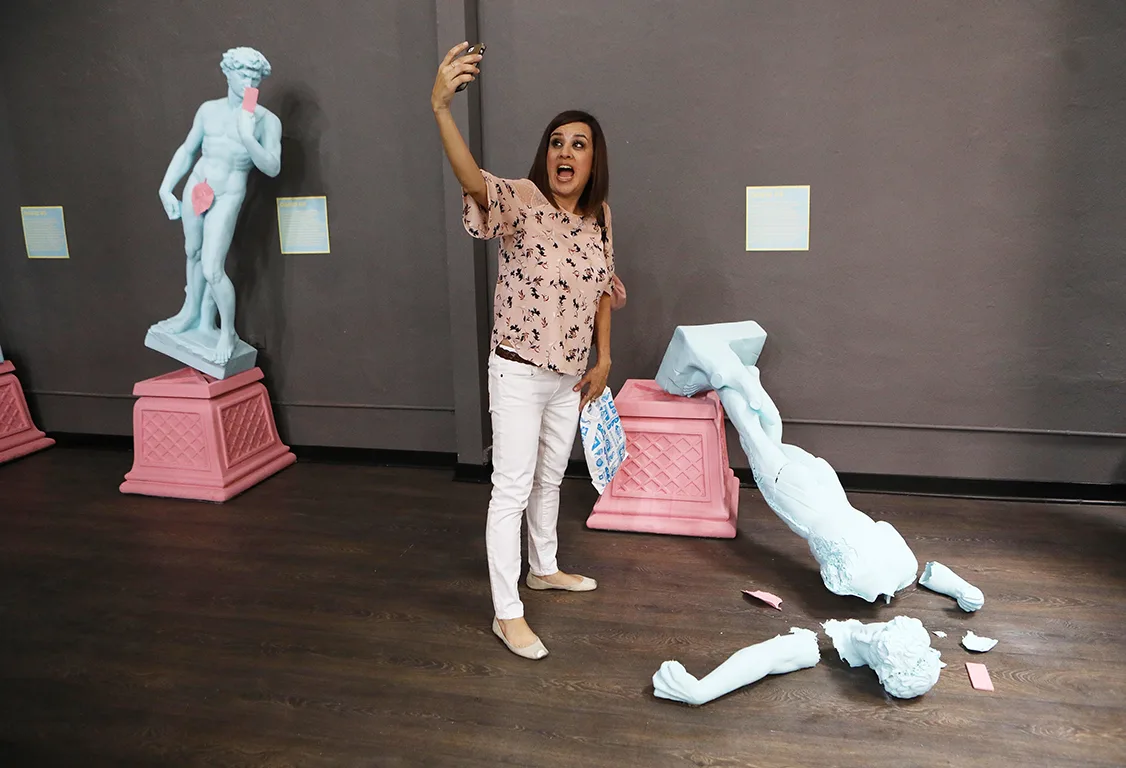
Michelangelo's David knocked from his pedestal by the selfie culture.Photo: Mario Tama/AFP
Positive ripples
Is there no counter-current to this cultural trivialisation? Most certainly. Museum attendance in the Netherlands has been rising for several years—a trend only partially explained by the influx of foreign visitors. Internationally, the creative sector’s capacity for self-correction is also evident. In this industry, quality is once again becoming paramount. From its heart, a new discipline has emerged that is already larger than the film and music industries combined: Gaming. The narrative dynamics of Role-Playing and Art & Exploration games are particularly sophisticated, merging music, film, storytelling, and interaction into a platform-independent medium. This has led to immersive book forms in game format, such as Skipping Stones (KO_OP) and Dear Esther by Dan Pinchbeck—a haunting tale that unfolds as the reader takes a virtual walk through the dunes. And for those parents concerned about their children's excessive gaming: don't be. It may actually be making them sharper—at least according to Albert Posso of the Royal Melbourne Institute of Technology.32 Posso’s research suggests that young gamers score significantly higher in mathematics and literacy than their non-gaming peers who spend their time on social media.
Proven Plateau-Trivialisation
All's well that ends well, one might say—or is it? Those who believe trivialisation is a fading trend will be disappointed. The reason lies in a new market phenomenon: proven plateau-trivialisation. It operates as follows: high-quality concepts with a proven track record are increasingly used as a template for 'new' products. While this maintains a baseline of quality, it stifles genuine innovation.
An author thus risks having their contract terminated prematurely should they become the target of public outcry.
From a commercial perspective, this is understandable: why conceive new storylines when you can endlessly repurpose past successes? Sophisticated algorithms now dictate exactly what resonates best with consumers. In this view, experimenting with unproven ideas constitutes an unnecessary financial risk—especially in major projects driven by the need for immediate impact. Curiously, the aforementioned susceptibility to trends plays a secondary role here. The market is becoming more conservative, a shift driven largely by the influence of social media.
Platforms like Facebook, X (formerly Twitter), and Instagram have become powerful engines of this plateau-trivialisation. An author who pursues innovation or steps outside their comfort zone risks clashing with conventional views or specific subcultures. This often leads to friction with groups who feel they 'own' a particular narrative or sentiment, resulting in vitriolic backlash under an aggrieved [#politicalcorrectness] hashtag. This development is cause for reflection: is it not precisely the author’s task to stray from the beaten path, to provoke, and to offer fresh insights?
Sensitivity Readers
Increasingly, publishers in the United States are adopting a different stance, incorporating so-called 'morality clauses' into author contracts. An author thus risks the summary termination of their contract should they become the target of public outcry. Furthermore, 'sensitivity readers' are increasingly employed to vet manuscripts for perceived offences regarding ethnicity, sexuality, health, and class. Some authors, such as Lionel Shriver, view this as a form of censorship. In an interview with The Guardian,33 she questioned how readers can ever hope to understand the world of Donald Trump if fictional characters are only permitted to harbour politically correct thoughts.
It is a precarious path, as Amélie Wen Zhao discovered. Earlier this year, she withdrew her novel Blood Heir following accusations of racism on social media.34 With her fictional story of an oppressed group, the author had intended specifically to expose human trafficking and forced labour in Asia. However, the advance review copies sparked a firestorm of criticism. Ultimately, her debut was released this year, but only after the manuscript had been revised based on the feedback of sensitivity readers.

The choice rests with the public.Photo: Brett Sayles
The Final Word
It appears, then, that 'proven plateau-trivialisation'—which might be visualised as a flowery highland devoid of distinct colour—poses a genuine threat to the cultural landscape. It results in predictable products that offer readers, viewers, and listeners little in the way of substantive innovation. In this light, it is hardly helpful that film studios, for instance, increasingly forgo press screenings and previews.
As a viewer, you no longer know in advance whether a new release, such as Crawl, is truly worth your time. This development is not entirely incomprehensible; many critics, whether consciously or not, also facilitate this market trivialisation. Their once-vital role has frequently been relegated to the final item on a dwindling editorial budget or is outsourced for a pittance. Consequently, there are fewer critics remaining who can interpret a work purely on its merits, free from conflicts of interest. But does it matter? In an era of digital cultural populism, everyone is a critic, and according to journalist Neal Gabler, the professional critic has long since lost his authority.
Plateau-trivialisation, therefore, is not the sole responsibility of the creative industry or social media, but a broader societal phenomenon. The final word, as always, rests with the public: will they seek out a counterculture, or would they rather continue grazing on the proven, consensual highlands?35