- 73. Kellerhoff, S. (2024, 3 January). Diese Bildikone des Judenmordes ist endlich entschlüsselt. Welt.↩
- 74. The primary photograph in this contribution depicts Camp Westerbork (Drenthe). Constructed in 1939, Westerbork served as a transit camp for extermination centres such as Auschwitz and Sobibor, and was colloquially known as the Pforte zur Hölle (Portal to Hell). ↩
- 75. Striking in the photograph is the apparent serenity and dignity of the victim as he gazes upon the fate awaiting him. It suggests he may have attained a sense of peace with his destiny.↩
- 76. Sabotage carried a dark corollary. The featured letter from 1941 compelled Dutch citizens residing nearby to be present at night for several hours at locations designated by the occupier. They were thus held involuntarily liable for infrastructure susceptible to sabotage. This was not without peril; these summons (1941–1944) also specified locations near Twente airfield, which was bombarded on several occasions.↩
- 77. This would suggest character assassination—a tactical deflection designed to damage the individual, force them into a defensive posture, and stifle substantive discourse. Character assassination is manifest not only within the political arena but also within governmental organisations plagued by a culture of concealment. It is employed to suppress critical voices and internal malfeasance. In a culture devoid of robust enforcement and effective oversight, managers may abuse their mandate to eliminate principled officials through character assassination when intimidation and manipulation fail. Consequently, structural issues and abuses remain obscured, as the preservation of one’s position takes precedence over substance. Similarly, the Childcare Benefit Scandal was allowed to escalate entirely out of control because the existing checks and balances failed to function in practice. It would therefore not be surprising if it ultimately transpires that no demonstrable complaints against the Princess exist, proving them to instead be entirely fabricated.↩
- 78. See also: Mann, T. (1924). The Magic Mountain ['Der Zauberberg'], Translation Hans Driessen. De Arbeiderspers 2014-2016.↩
- 79. See also the statistics from the OCHA (Office for the Coordination of Humanitarian Affairs) of 18-9-2024. (Mirror)↩
- 80. In the Netherlands, the Centre for Information and Documentation Israel actively combats antisemitism (CIDI). At the end of 2023, they observed a staggering 145% increase in reports of discrimination compared to the previous year, with 155 reports in 2022 against 379 in 2023.↩
- 81. Through this contribution, I have sought to clarify that Israel and the Holocaust must be distinguished from one another, while delineating the context in which these events transpire. This is not an argument for or against any particular group; every civilian casualty is one too many. War and terrorism are (amplified by social media) instruments of a political agenda. This recalls my earlier observation in the contribution regarding Black Lives Matter: "As is widely acknowledged, within the political sphere, truth and reality do not always coincide." The ease with which human lives are currently decimated—consider the conflicts surrounding us—demonstrates that the essence of the Holocaust has not yet concluded and that our political leaders have failed to learn. For this reason, the Holocaust must never become a forgotten page or a politicised pamphlet. Every human life is of consequence, also beyond the 5th of May.↩
“No Borders, No Nations, No Deportations"
NO RIVER, NO SEA
Beyond All Boundaries
Category: Current Affairs
| Monday, 30 September 2024For this penultimate chapter, I had envisioned a more sanguine subject; however, as the preceding contributions have illustrated, the zeitgeist possesses a prerogative of its own. Regrettably, the world is not always as sublime as it might—or indeed ought—to be. In 2018, I commenced the drafting of these reflections, several of which serve as a cultural mirror to the world as it then manifested. Whilst adhering to the ultimate objective of this volume and employing shifting perspectives, the content has remained predominantly a reflection of the prevailing spirit of the times. Every year found its place within these pages, with the singular exception of 2023.
OpenAI might well have constituted a relevant subject for 2023, yet I had already devoted a contribution to that phenomenon as early as 2020. That particular narrative left me with a lingering sense of acrimony when it transpired that OpenAI, awash with capital, had surreptitiously plundered the works of writers and artists for its parasitic ChatGPT and Dall-E applications. I cannot speak for you, the reader or fellow author, but AI-generated content finds no resonance within me. I withdraw, repelled by a profound lack of authenticity; furthermore, I consider it a substantive insult to the reader's intellect. Its utility, after all, is predicated upon the creation of a facsimile of that which already exists. Now that GenAI has failed to deliver on its hyperbolic promises and investors are beating a retreat, one hopes that interest will pivot once more toward originality.
Following my analysis of the conflict between Ukraine and Russia in 2022, I did not anticipate that a new conflagration of such magnitude would erupt so soon thereafter. According to the Geneva Academy, the global tally of armed conflicts has now reached 110. The prevailing war between Israel on the one part, and Hamas, Hezbollah, the Houthis, and Iran on the other—an escalating struggle—is particularly striking, as is, perhaps, my treatment of the subject on this occasion.
That Seventh Day of October
On the 7th of October 2023, whilst many soldiers were on leave during the Jewish festival of Simchat Torah, Hamas terrorists breached the perimeter fences separating Gaza from Israel. Under a barrage of rocket fire, they unleashed a lethal assault upon every Israeli in their path, sparing not even infants. Before the gaze of their own recording devices, the most heinous massacre since the Holocaust unfolded. One thousand two hundred souls perished in the attack, and nearly one hundred and fifty thousand citizens were evacuated. Furthermore, two hundred and fifty-one individuals were forcibly abducted.
Global reactions have been starkly divided, and the Netherlands is no exception. Although the public denial of the Holocaust is a statutory offence, the celebration of the October 7th atrocities appears to be sanctioned here. The psychological nadir one must reach to engage in such conduct lies so far beyond my own sphere of experience that I lack the empathic capacity to comprehend it. Nevertheless, certain authorities exhibit a limitless degree of tolerance, rationalising it under the guise of democracy.
Wahnsinn in höchster Potenz.
The Israelis, fortunately, possess a resilient spirit—a fact even the Palestinian terror group Black September encountered during the 1972 Games, when they orchestrated a bloodbath within the Israeli quarters of the Olympic Village. On that occasion, wrestling coach Moshe Weinberg and weightlifter Yossef Romano unwittingly assumed heroic roles; through their athletic prowess, they saved the lives of two other hostages and momentarily overpowered their captors. A fair final, however, was denied them in Munich. Owing to the depraved conduct of the opposition (the harrowing details of which I shall spare you), eleven hostages ultimately lost their lives. The 'medals of honour' were reserved for the perpetrators, delivered outside the stadium in the form of lead.
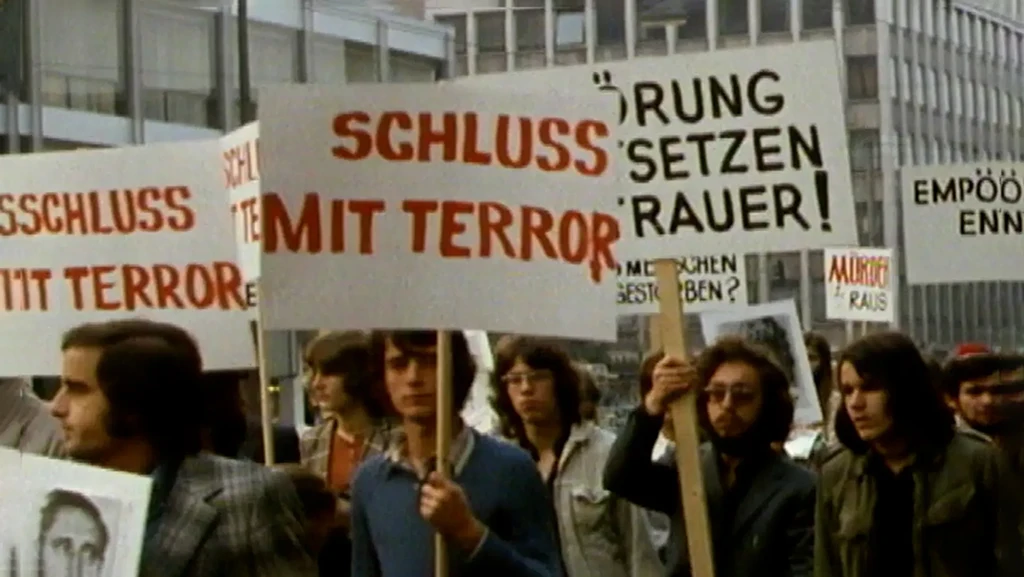
Germans protesting against terror (1972).Photo: Britannica
The aforementioned events are not isolated incidents but part of a recurring pattern. In those days, such assaults were unequivocally termed acts of terror and their perpetrators terrorists; today, the vernacular has shifted to 'fighters'. A 'struggle' against civilians that transcends all human boundaries and has, thus far, yielded no resolution. And unlike the demonstration captured in the photograph, contemporary protests are increasingly pro-terror—a shift we find ourselves regarding as disturbingly normal.
For some, Munich has not been consigned to oblivion. To 'celebrate' the 52nd anniversary of the Munich massacre, a gunman opened fire on the Israeli consulate in Munich on the 5th of September 2024. My 'congratulations'—but in the name of peace, for what exactly?
An Alternative Paradigm
Let me begin by positing that the Palestinian populace in the Gaza Strip and Hamas militants must not be conflated. Much like the average Israeli citizen, many inhabitants of Gaza (and the West Bank) desire nothing more than a secure and sustainable existence. A prospect that, incidentally, is also eluding an increasing number of people in the Netherlands, though that is a tangential observation. The presence of a missile in one’s home—whether launched by Israel or pre-installed in one’s cellar by Hamas—finds no place in such a vision. In Lebanon, the narrative is fundamentally similar, albeit with Hezbollah operating in the South.
According to 'our man in Tehran', Thomas Erdbrink, the Iranians in the more distant hinterland are not unkindly people. Whilst on paper much is proscribed, in practice, the reality is far more nuanced. No, it is primarily the religious theocratic regime that prosecutes a proxy war against all things associated with Israel. And yes, in that worldview, the West is hardly celebrated, yet this remains predominantly a political construct.
Victims who have waited far too long for a restoration of damages that are, in truth, beyond all possible compensation.
Furthermore, Israel itself is home to Palestinians, often referred to as Israeli Arabs, who are predominantly native-born. All inhabitants are Israeli citizens holding the same passport, yet a distinction is made based on nationality, with Jewish and Arab being the most prevalent. To be Jewish and to be Israeli are, therefore, not inherently synonymous. For this reason, I was profoundly unsettled by the news on the 13th of March that approximately a thousand pro-Palestinian protestors at Waterlooplein had disrupted the ceremonies marking the opening of the National Holocaust Museum in Amsterdam. No fewer than thirteen 'demonstrators' were apprehended by the constabulary. Once more, I am compelled to ask where the psychological nadir lies that necessitates such an expression. The Holocaust is the darkest chapter of our modern history, occurring in an era when the State of Israel did not yet exist. The intervention in Amsterdam thus betrays a complete absence of historical consciousness.
The jeering directed at King Willem-Alexander was equally striking. The King simply merits more respect. If only for the fact that he did not obfuscate the discovery of his grandfather Prince Bernhard’s NSDAP membership card—a membership the Prince had denied throughout his life—but chose instead the path of transparency. In his estimation, such records ought to be accessible to researchers and for the purposes of historiography. It is a glimmer of light in sombre times; at last, a leader who provides an exemplary precedent.
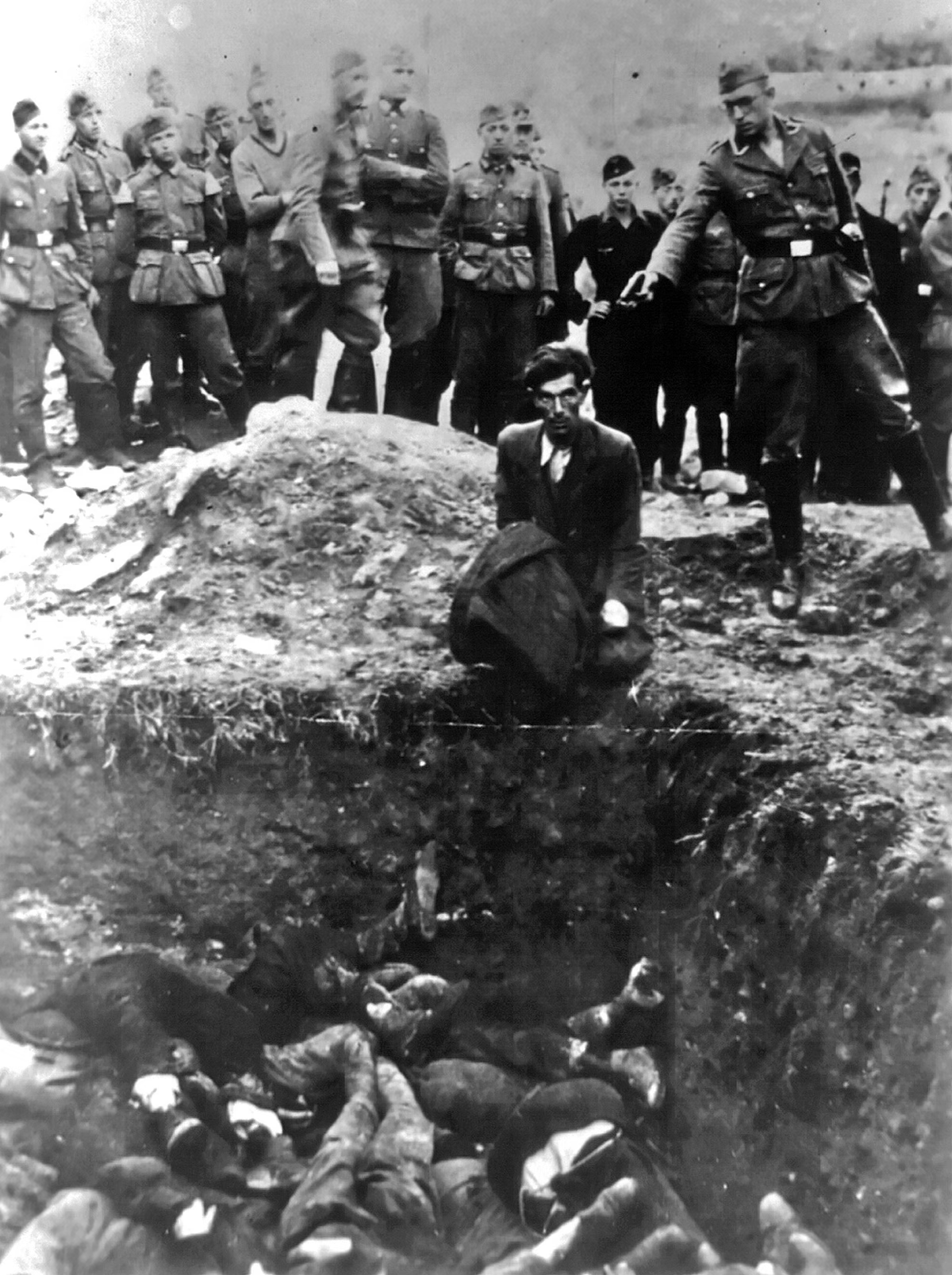
Execution of Jews by the SS in Berdychiv, Ukraine (1941).Photo: Holocaust Memorial Paris
The historiography of the Holocaust is, moreover, far from concluded. After eighty-three years, the location of the photograph above could finally be established with certainty due to the recent emergence of a second image.73 The photograph serves as a testament to the mass executions of Jews during the Second World War. On the reverse of the second photo, a pencilled inscription reads: "Wahnsinn in höchster Potenz" (Insanity to the highest degree). The image of the execution is harrowing, and I hesitated before including it; however, I believe it conveys the message with zulke clarity that its use is both functional and justified.
Lest we forget: a reiteration
During the Second World War, in addition to Jews, Roma and Sinti, homosexual, lesbian, convicted, and disabled HUMAN BEINGS were deported to concentration and extermination camps, gassed, or subjected to depraved experiments.74 These individuals were deemed (biologically) inferior by the Nazis, which in their eyes justified ethnic cleansing. It is often overlooked that genocide was also perpetrated against Polish civilians (1.8 million) and Russian prisoners of war (3.3 million). While Black people were not part of the deportations, they were subjected to the most severe forms of racism, manifesting in social exclusion and systemic persecution. In total, seventeen million people perished as a result of systematic murder based on ethnicity. Regarding Jewish victims, the Netherlands suffered the highest percentage of losses in Western Europe. This was due, in no small part, to the Dutch railways, which ran with a punctuality that explicitly delighted the Nazi executioner Adolf Eichmann.75 The primary cause, however, lay in the manner in which the Dutch civil administration facilitated the occupier at the time.
This stands in stark contrast to the February Strike of 1941, when many Dutch businesses closed their doors and tens of thousands of Amsterdammers took to the streets to protest against the German occupier. After two days, however, the strike was quelled, partly under pressure from the Amsterdam municipal government. Nevertheless, individual resistance persisted, including in the East of the country, where the railway lines approached the German border.76
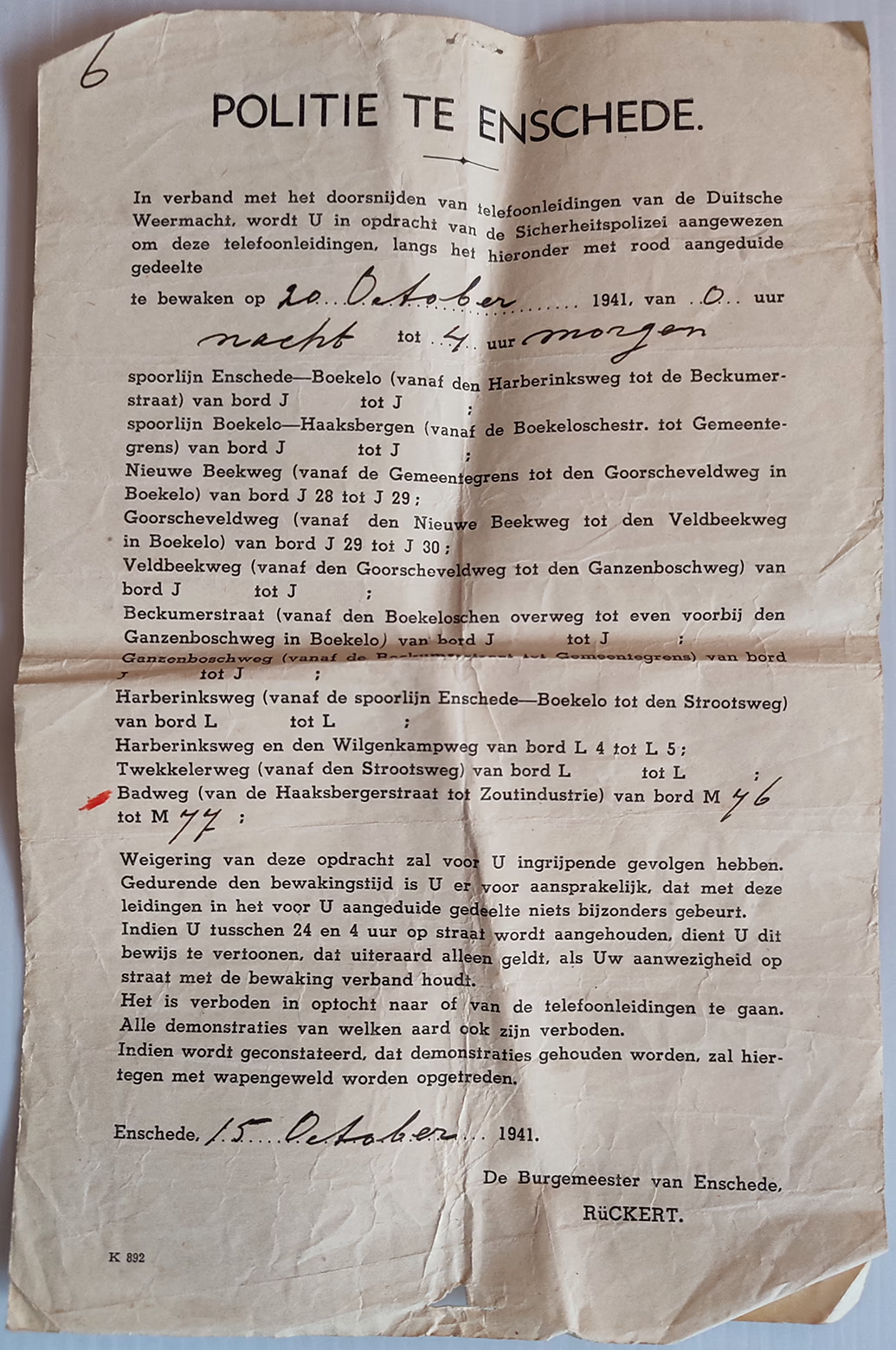
Silent resistance: severed telephone lines (1941).Photo: © Eikvos
One might dismiss these events as relics of a bygone era; however, the recent Dutch childcare benefit scandal demonstrates that ethnic profiling and discrimination based on social class remain entrenched within governmental structures, permeating even the judiciary. This latter aspect I find most egregious. While the victims of this scandal were not deported, their lives were nonetheless eviscerated—as were those of their children, who were forcibly removed by the state. It is noteworthy that another member of the Royal House, Princess Laurentien, took a principled stand by championing the victims' cause. These individuals have languished far too long awaiting restitution for damages that are, in essence, irreparable. The Princess’s foray into this political minefield, however, proved costly. In late August, it culminated in her resignation as chair of the (Equal) Worthy Recovery Foundation (Stichting Gelijkwaardig Herstel). The alleged cause: 'transgressive behaviour' toward officials at the Ministry of Finance. Be that as it may, this is but one perspective; the victims themselves afford no credibility to such a narrative.77
A similar sense of incredulity is evoked by the recurring reports of Jewish schools and synagogues being shuttered due to a lack of security. Many of these institutions have already been compelled to install ballistic glass. It is an ominous portent. Much as in the 1930s, when a comparable climate was allowed to coalesce in Germany, contemporary authorities once again avert their gaze. This leads potentially to a paradox of tolerance, or as the philosopher Karl Popper posited in 1945:
"Unlimited tolerance must lead to the disappearance of tolerance. If we extend unlimited tolerance even to those who are intolerant, if we are not prepared to defend a tolerant society against the onslaught of the intolerant, then the tolerant will be destroyed, and tolerance with them."
This is not, however, a license for violence against intolerance; rather, it is an appeal to rationality and solutions derived from reason, such as dialogue. Yet, should intolerance culminate in violence, the response may—and indeed must—be commensurate. We find analogous sentiments in Thomas Mann’s The Magic Mountain (1924)78, wherein he writes: "Tolerance becomes a crime when applied to evil." The renowned statue of the striking dockworker in Amsterdam (Mari Andriessen, 1952) stands as a bronze-cast testament and a reminder of the common man's resistance against intolerance and injustice.
Beyond All Boundaries
These burgeoning tensions cannot be viewed in isolation from the situation in the Middle East, which brings us once more to the Second World War. In its immediate aftermath, in 1945, Palestine was a mandate territory under British administration, coinciding with a period in Europe when surviving Jews sought to depart en masse for Palestine. The arrival of these Jewish citizens led to a UN resolution that partitioned Palestine into separate Jewish and Arab states.
Inevitably, this proposed coexistence ignited tensions across the Arab world, culminating in the 1948 Arab-Israeli War, virtually at the moment the United Kingdom withdrew from Palestine. The flared conflict placed the indigenous Palestinians in a precarious position. This was not solely attributable to Israel, which was then asserting its independence, but also to choices made by Egypt and Jordan, both of which had occupied Palestinian territories. The Palestinian people, caught in this pincer movement, effectively became a people without borders—a 'limitless' people dispersed throughout the region.
The question of historical entitlement to the land is frequently posed, yet it remains primarily an academic inquiry, given that prior to the Mandate era, the territory had been successively held by Jews, Romans, Babylonians, Persians, Mongols, Egyptians, and Ottomans. A staggering lineage of suzerainty.
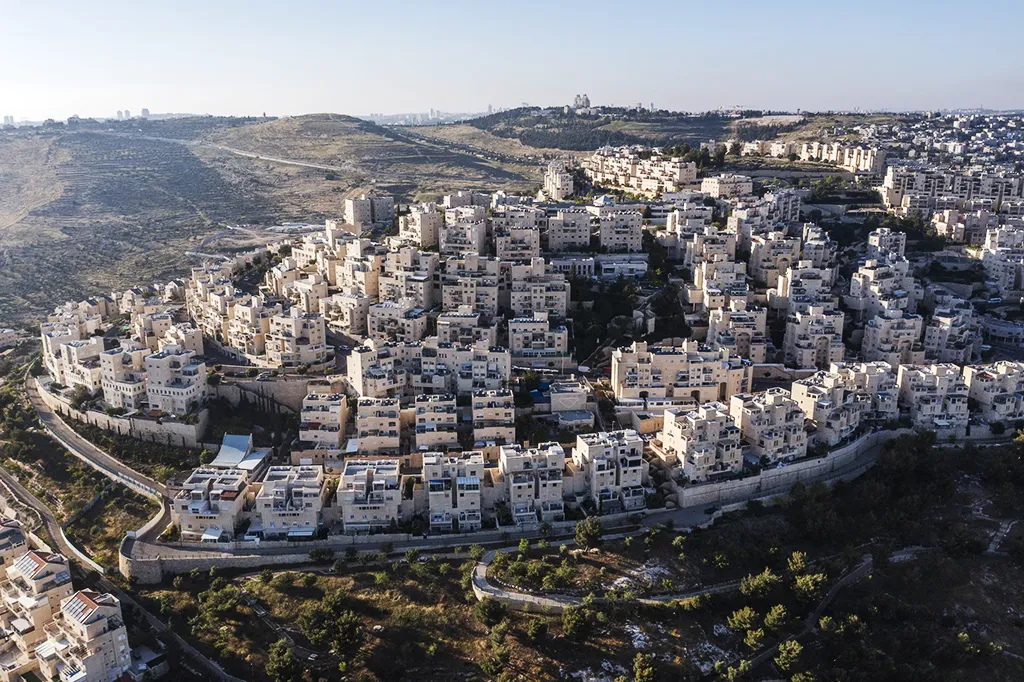
Israeli settlements on the West Bank.
Presently, the Palestinian population possesses a degree of self-governance only within the West Bank. This is essentially the only territory that returned to their control after King Hussein of Jordan formally renounced his claim to the West Bank in 1988, and the PLO proclaimed the State of Palestine. The PLO—the Palestine Liberation Organisation—then welcomed Yasser Arafat as its first president.
That space constitutes our shared foundation for forbearance.
Whilst the PLO has evolved into a recognised representative of the Palestinian people, Hamas and Hezbollah have never attained such status. Emerging from resistance against occupations in Palestine and Southern Lebanon, these organisations seek the destruction of the Jewish people and receive overt support from Iran. The significance attributed by these groups to the slogan frequently heard at pro-Palestinian demonstrations, "From the River to the Sea" (referring to the territory between the Jordan River and the Mediterranean), is therefore seen as antithetical to a two-state solution; instead, it is viewed as a symbol of violence directed at Israeli civilians. Over the past decade alone, several thousand terrorist attacks have been recorded within Israel itself.
The repercussions of this violence are increasingly manifest in Europe, directed against Jewish communities who bear no responsibility for the situation in Israel. This has transformed into a European crisis where indifference is no longer an option—a sentiment that applies equally to the plight of the Palestinians. So long as Israel perceives its existence to be under threat, a two-state solution remains more elusive than ever. Conversely, such a resolution presents a daunting prospect for nations like Jordan, which fears the emergence of a 'terrorist stronghold' in proximity to its borders. Furthermore, the intricate entanglement of Hamas within the fabric of Palestinian civil society remains exceptionally difficult to unravel. Yet, beyond the shadow of terror, there is hope for a peaceful future for the Palestinians, encompassing also their own place by the river and also their own vista over the sea. Or, quite simply: perspective. This necessitates, inter alia, a cessation of Israeli settlement construction in the West Bank. The Palestinian people have endured fragmentation for far too long; for them, the humanitarian limit79 has been reached. However, a distinction must be made between this and the Holocaust. That suffering was too profound and too immense to be politicised, as occurred recently in Amsterdam.
Moreover, it would be naive to presume that a resolution to the aforementioned conflict would result in the eradication of antisemitism from the world.80 Some fear that the Middle Eastern predicament may remain eternally insoluble. The root causes possess much deeper foundations, currently anchored not so much in Islam as a religion or the underlying Quran—which contains both positive and disparaging references toward Jews and Christians—but in specific political strands of Islam. In this regard, the role of Iran is pivotal, raising questions about whether Hamas ('Zeal') and Hezbollah ('Party of God') will ever be dismantled, and whether a future Palestinian state will possess its own military force. In all matters, however, context is paramount, as is the collective will to perceive the totality of these interrelated factors.
Within Europe, a separation of state and religion is maintained, ensuring that neither exerts influence upon the other. This is not to suggest it is the quintessential form of governance, yet for seventy-nine years, it has afforded a reasonably secure sanctuary for every individual, regardless of their worldview. That space constitutes our shared foundation for tolerance. The contemplation of limitless improvement has a place within that framework; ideological erosion does not.81