- 56. Ukraine was traditionally a toponym and was therefore frequently referred to as 'the Ukraine'. Following its independence in 1991, however, it became a sovereign state. As a general rule, the names of independent nations are not preceded by a definite article.↩
- 57. Alla Surikova (Director). (1987). A Man from Boulevard des Capucines. Mosfilm production.↩
- 58. The Ministry of Foreign Affairs of the Russian Federation. (2019, 12 March). Comment by the Information and Press Department on the expiry of the Russian-Ukrainian Friendship Treaty of 1997. Via mid.ru.↩
- 59. VRT NWS. (2014, 27 June). Ukraine signs 'historic' association agreement with Europe. Accessed 28 June 2022, via www.vrt.be.↩
- 60. North Atlantic Treaty Organization (2008, 3 April). NATO decisions on open-door policy. [nato.int].↩
- 61. Survey, Lord Ashcroft Polls, 28 June 2022 (mirror).↩
- 62. See also: Davies, B. L. (2016). The Russo-Turkish War, 1768-1774: Catherine II and the Ottoman Empire. Bloomsbury Academic.↩
“I don't know who sold our homeland, but I saw who paid the price.”
GLOBAL CONFLICT
The Contraction of the Kievan Rus'
Category: Current Affairs
| Wednesday, 1 June 2022 (updated 1 July 2022)On the 24th of February 2022, Russia launched an invasion of Ukraine, an event that profoundly upended the European order.56 It represents the 63rd entry in the current catalogue of global conflicts. One of these—the Kurdish separatist movement in Iran—traces its origins to an era preceding the conclusion of the First World War. Such historical longevity also characterises the friction between Russia and Ukraine; for centuries, they shared a common genesis within the Kievan Rus'. Yet, this heritage now appears as mere marginalia; after three months of sustained warfare, both parties stand in absolute opposition. Can a genuine reconciliation between Russians and Ukrainians ever truly be achieved?
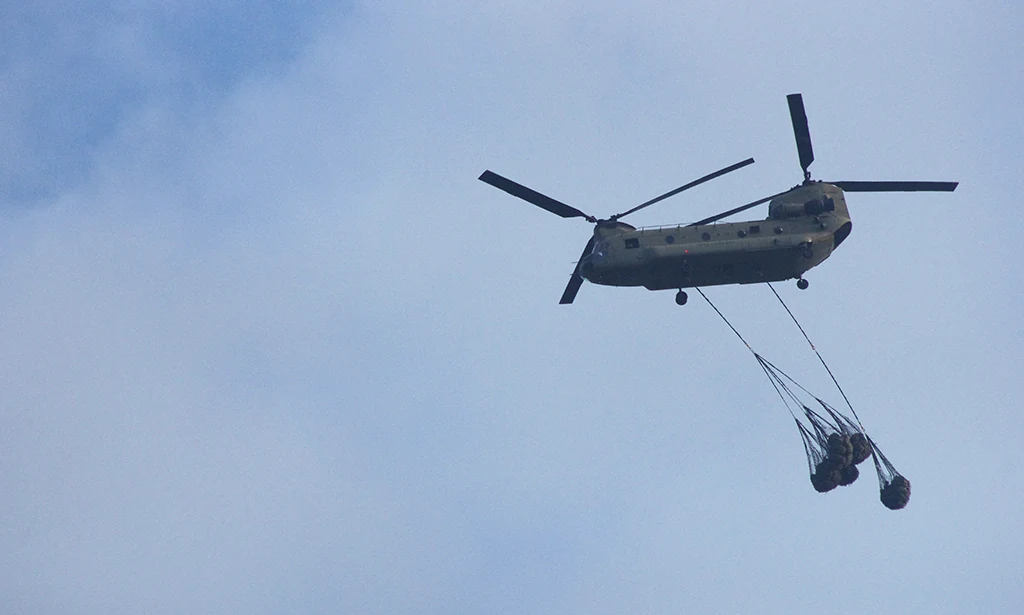
An American Chinook during a NATO exercise in support of Ukraine.Photo: R. Wilcher
Cascades of Missiles
Whilst the entirety of Eastern Ukraine is bathed in crimson on the digital radar map Повітряna тривога, I am engaged in a digital exchange with Vanko—a close acquaintance residing in the environs of Kyiv. Red signifies that missiles are in transit; and indeed, shortly after eight o'clock, Russia launched eight Kalibr cruise missiles from the sea. That the internet remains functional is a providence for Vanko; it provides not only a vital distraction but also serves as a conduit for disseminating information regarding the struggle. This information, however, offers little solace. Whereas in the initial months he was consumed by the dread of being struck by Russian ordnance or artillery, I now observe that his fear has mutated into a form of stoic resignation. Nevertheless, he remains apprehensive regarding the trajectory of the two missiles currently hurtling towards Kyiv. And that is not even his primary concern.
Vanko no longer harbours the slightest sympathy for anything remotely associated with Russia.
His employment in Greece was terminated by his employer a fortnight ago. After all, Vanko is no longer permitted to depart from the country. During our weekly discourse, I continue to seek out sparse glimmers of hope, such as the fact that the mandatory curfew in his district—enforced by a strict blackout at eleven o'clock—has recently been lifted. A meagre consolation, as Vanko is well aware that he may soon be conscripted to play his part in the combat. Consequently, he exists from one day to the next. When queried on his stance, he responds with unwavering resolve: "Yes, I shall have to fight, and I shall be ready at any moment. Everyone fights: women, girls, boys, men, and even the elderly."
Vanko no longer harbours the slightest sympathy for anything remotely associated with Russia. Given the testimonies I have gathered over the past months, his sentiments are entirely intelligible; such is the corrosive nature of war upon the human psyche. This stands in stark contrast to Dima, a Ukrainian engineer from Crimea with whom I shared a brief voyage upon the Russian Oka during my student years. Although his great-grandfather fought fanatically against Stalin, Dima studied in Moscow, where he also met his wife. For him, the situation is far less binary. I, too, find it difficult to hold the entire Russian populace accountable for the hostilities. Not only because so many Russians and Ukrainians are bound by ancestral ties, but primarily because this remains, above all, a political war.
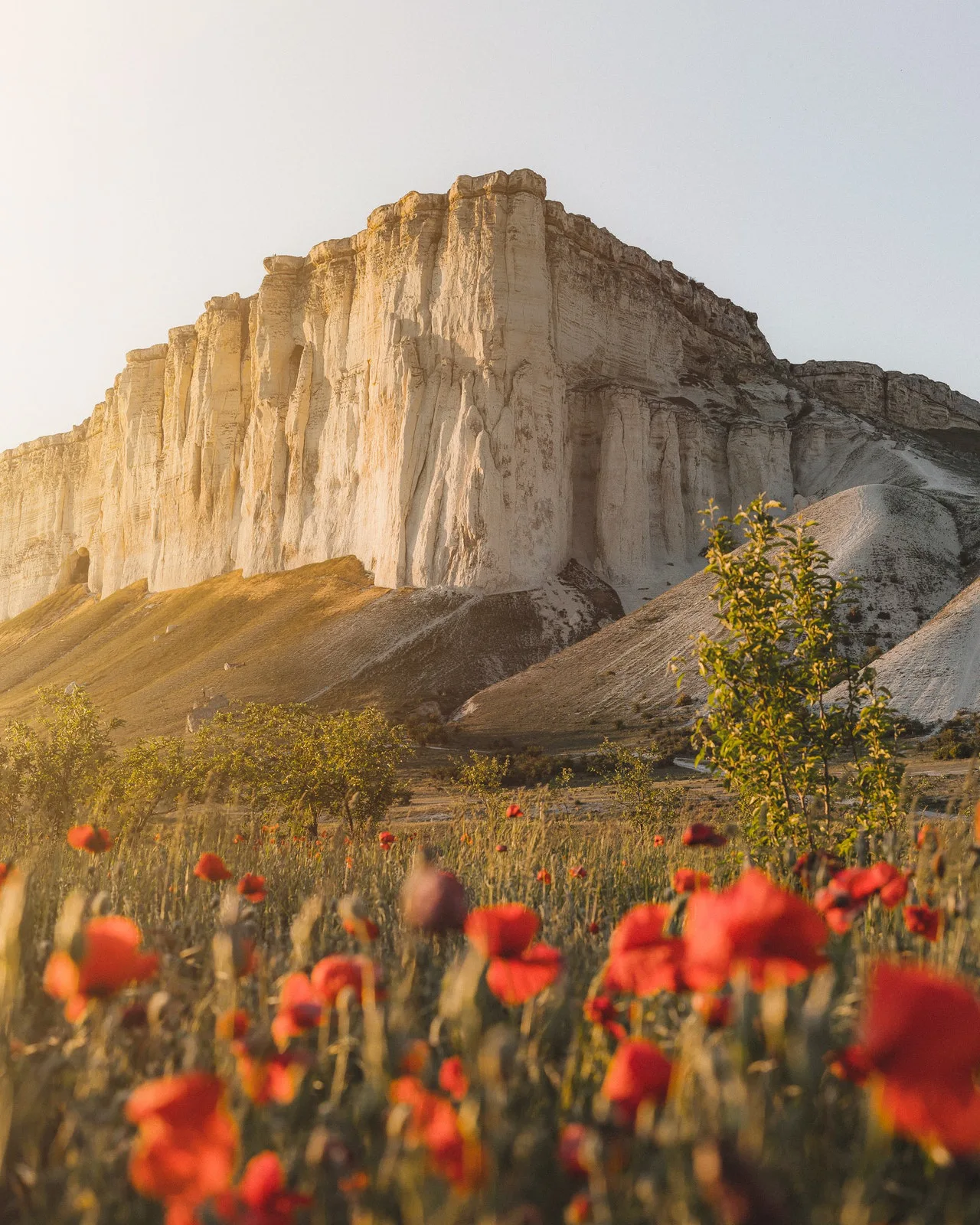
The white escarpment of Bila Skelya (Crimea). Photo: Fillvlad
The Rock of Recognition
A retrospective glance reveals that Ukraine and Russia long constituted a dyad—a duality forged primarily by Ukraine's tenure as a Socialist Republic within the erstwhile Soviet Union (USSR). This relationship did not vanish but underwent a fundamental transformation when Ukraine embarked upon its path as an independent democracy in 1991. Yet, almost every inhabitant of the former USSR and its socialist satellites remains intimately acquainted with the sublime vistas of Bila Skelya in Crimea. This landscape, defined by its characteristic white rock, served as the cinematic backdrop for numerous 'Westerns' produced within the Soviet Union, such as Chelovek s bulvara Kaputsinov (1987).57 Consequently, these Crimean-made films earned the sobriquet Red Westerns. Tragically, this very same Crimean stage became the theatre for an authentic shoot-out between Russia and Ukraine in 2014—the second such occurrence, following the 1917 Bolshevik invasion. At that time, the Ukrainian 'White Army' succeeded in repelling the 'Red Army' from Crimea, though this ultimately failed to prevent Ukraine from falling under Russian dominion by 1921.
This inevitably prompts the inquiry: how does Crimea relate, in a historical sense, to the Ukrainian sovereign state?
Germans, Bolsheviks, and the White Army
The shared history of Ukraine and Crimea spans centuries, marked by frequent shifts in Crimean suzerainty. The peninsula only came under Russian rule in 1783, when it was annexed from the Ottoman Empire by Catherine the Great. It remained thus for a considerable duration. Turbulence only returned to Crimea during and shortly after the First World War, as the territory fell successively into the hands of the Germans, the Bolsheviks, and the White Army. This period coincided with an exceptionally brief interval of independence for both Ukraine and Crimea, enduring until 1921. Subsequently, Ukraine continued as a Soviet Republic—without the once-again Russian Crimea—until, in 1954, the inconceivable transpired. The Russian leader Khrushchev decided, upon his own initiative, to 'gift' Crimea to the Ukrainian Republic. Khrushchev, although ethnically Russian, held a profound affinity for Ukraine and regarded Crimea as a natural extension of the Ukrainian steppes; furthermore, he posited that Crimea was more economically congruent with Ukraine.
Thirty-seven years elapsed before Ukraine and 'its' Crimea finally achieved independence. Provisions remained in place with Russia regarding the joint utilisation of the naval port of Sevastopol on the Black Sea. Yet, the matter was far from settled. Not everyone in Russia viewed the previous gift of Crimea with equanimity, and it remained a point of contention that was only temporarily resolved in 1997. In that year, a treaty was ratified recognising the borders of Ukraine and Crimea. However, this recognition was not perpetual; it officially expired in 2019.58
The Reluctance to Relinquish
Russia found itself unable to truly relinquish Crimea. In the post-Soviet era, the westward-looking focus of the Ukrainian populace was observed with growing resentment. During the 2014 annexation, however, the primary catalysts appeared to be the strategic military importance of the naval base and the vast gas reserves within the Black Sea. Russia itself maintained the position that military unrest in Ukraine—where a new pro-EU government had seized power—posed a direct threat to the resident Russian population and Russian interests. At that juncture, nearly 60% of Crimea’s inhabitants identified as ethnically Russian.
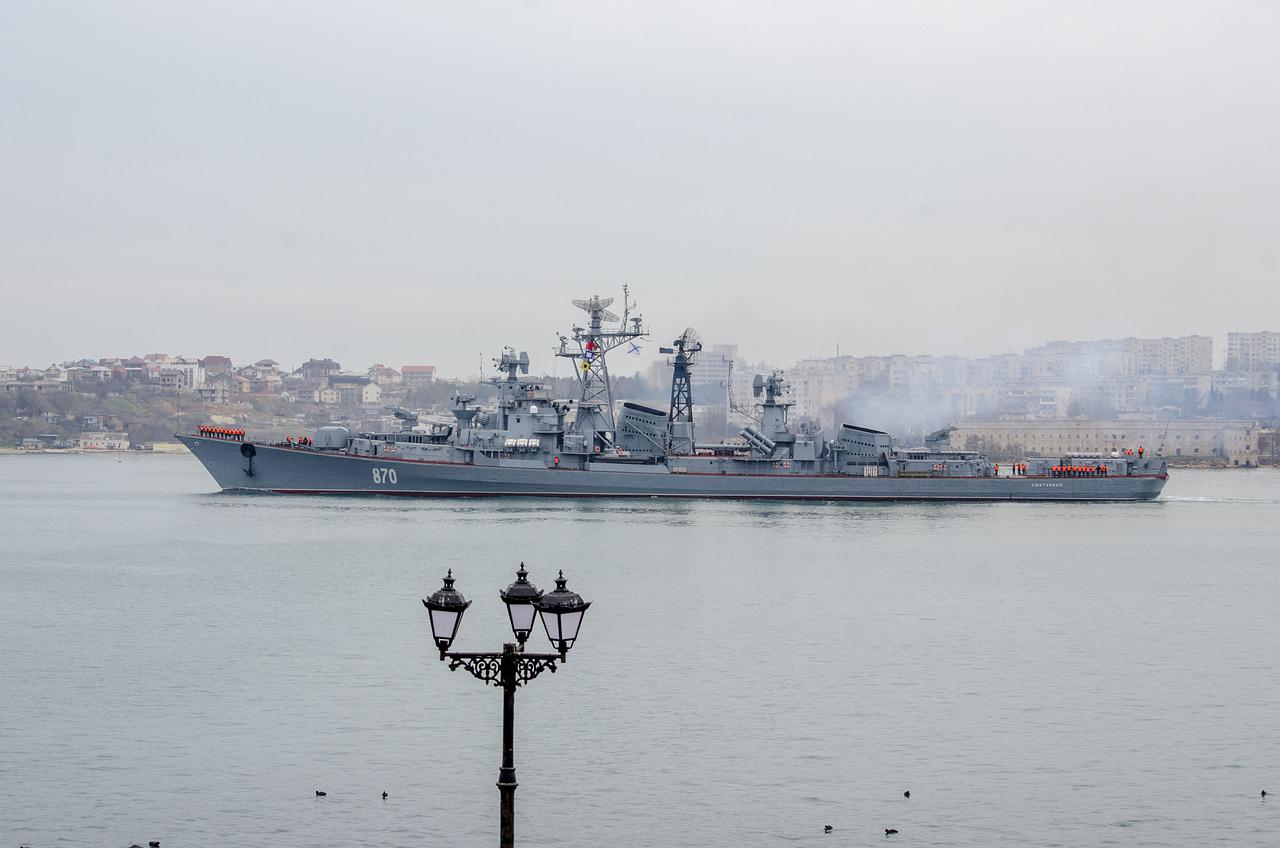
A Russian Kashin-class destroyer in Sevastopol (Crimea). Photo: Dmitry Osipenko
The annexation, however, did not prevent Ukraine from entering into an Association Agreement with the European Union (EU) or from seeking expedited accession to NATO and the EU.59 This is a right inherent to every sovereign and independent democracy. In this context, it is noteworthy that the Ukrainian military had already been receiving increasingly intensive training from NATO since 2014. For Putin, this represented the prelude to an intolerable 'doomsday scenario': the emergence of a pro-American democracy directly upon Russia’s threshold. Moreover, the prospect of NATO membership—signalled as early as the 2008 Bucharest summit—was particularly contentious, given the historical protocols regarding the Russian military presence in Crimea.60
A Final Overture
As tensions escalated throughout 2021, Russia issued a formal entreaty to NATO and President Biden on the 17th of December, requesting that Ukraine be barred from NATO accession and that no offensive weaponry be stationed along the Russian frontier. When this request was disregarded by the parties involved, Russia’s patience reached its nadir. In the nascent hours of the 24th of February 2022, it launched an invasion of Ukraine, precipitating a large-scale conflict that placed West and East in absolute opposition. The signal from the erstwhile conductor of the Soviet Union was unequivocal: "We are revising our departure from present-day Ukraine." This gambit, however, proved counterproductive: on the 23rd of June, the EU granted Ukraine expedited candidate status, with Moldova following in its wake.
To comprehend the profound historical bonds between Russians and Ukrainians, one must look beyond the horizon of the former Soviet Union.
Was it judicious, within the context delineated above, for the EU, NATO, and Ukraine to engage in such an intimate flirtation? Candidly, the answer remains elusive. There are Ukrainians, such as Vanko, who maintain that Putin’s teleological aim was always the restoration of the former Soviet empire’s 'glory'. What is manifest, however, is that as a consequence of this geopolitical chess match, the ultimate price is currently being exacted from the Ukrainian populace. They find themselves ensnared in a war of attrition, while the West, thus far, remains largely on the sidelines. This conflict is rendered all the more harrowing when one considers that numerous families in both nations share a heritage and roots that span both territories. The question remains as to what this portends for the future.
A Future Oriented Towards the West
As the preceding observations suggest, the democratically elected government in Kyiv remains steadfast in its westward orientation, despite the immense duress of the war. This trajectory is further substantiated by recent research conducted by Lord Ashcroft Polls in Kyiv.61 The findings indicate that approximately 93% of Ukrainians now perceive their nation’s future as being aligned with Europe rather than Russia. Whilst a degree of circumspection is warranted, one may cautiously conclude that the populace harbours a definitive preference regarding their destiny. The study also reveals that a vast majority of Ukrainians hold a negative perception of Putin (97%) and the Russian military (94%), with 64% expressing similar sentiments regarding the Russian citizenry. One might expect such figures to signal an imminent fracturing of society; fortunately, this is not the case. Nearly two-thirds of the respondents believe that, despite their differences, there is more that unites the ethnic Russians and Ukrainians residing within Ukraine than divides them. Notably, almost ninety per cent of respondents of Russian ethnicity underscored this sentiment—a fact that offers a glimmer of hope amidst the current conflagration.
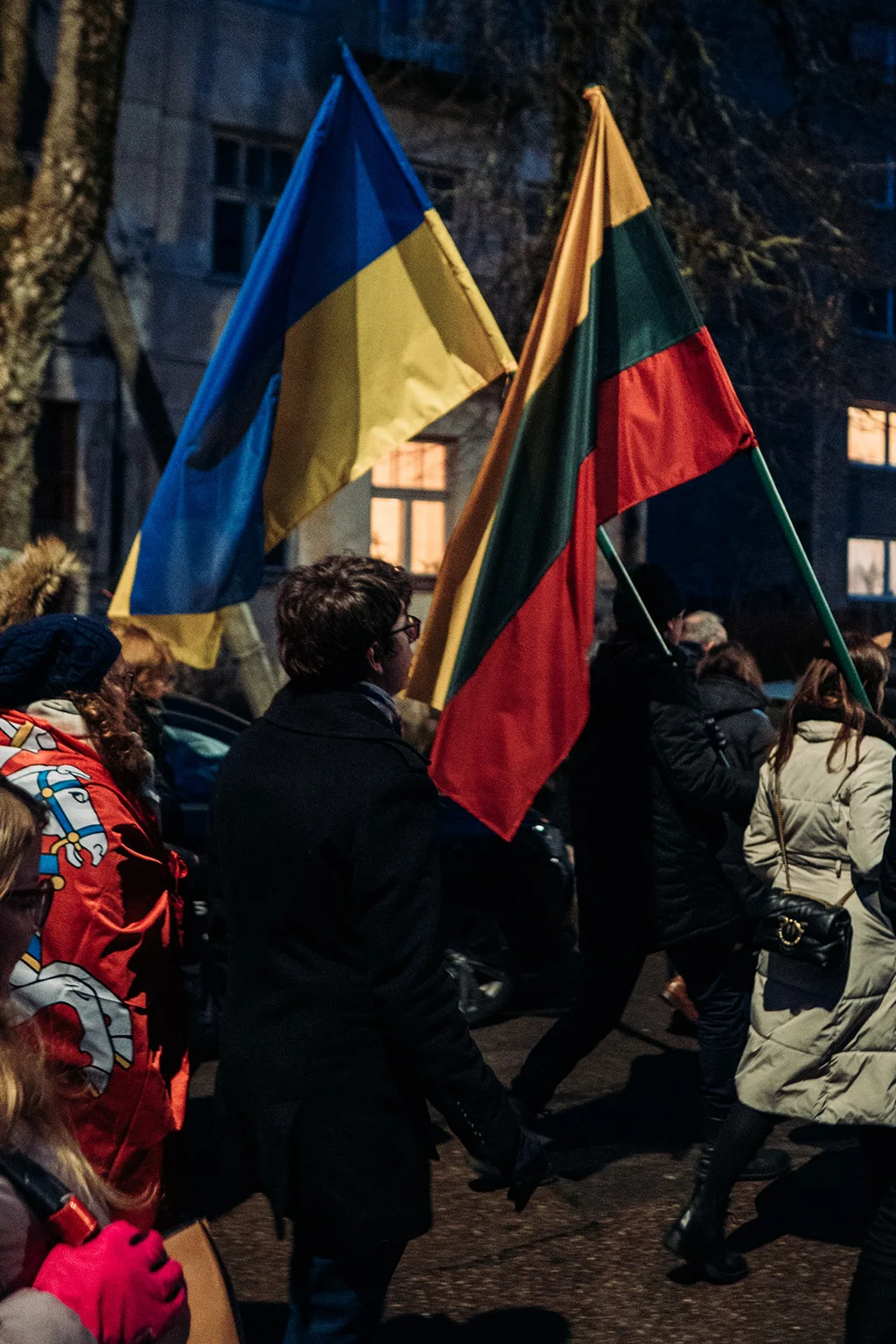
A peace march in Lithuania protesting the war in Ukraine.Photo: Artūras Kokorevas
The central inquiry, then, is how Ukrainians and their ethnically Russian brethren continue to perceive these commonalities despite the prevailing circumstances.
The Kievan Rus'
To comprehend the profound historical bonds between Russians and Ukrainians, one must look beyond the horizon of the former Soviet Union. For this, it is most judicious to return to the cradle of East Slavic civilisation: the Kievan Rus'. This empire emerged in the 9th century when the Scandinavian Varangians conquered the city of Kyiv. Its frontiers subsequently expanded to encompass Belarus and a vast portion of modern-day Russia. Until its eventual collapse in 1242, this immense territory was governed not from Moscow—which fell to Mongol forces in 1238—but from its capital, Kyiv. It is therefore hardly surprising that Belarusians, Russians, and Ukrainians alike regard the ancient Kievan Rus' as their common ancestral origin.
The period of Mongol suzerainty, gradually succeeded by the dominance of the Ottoman Empire, did little to alter this foundational perception. In fact, Russia—which had begun to extract itself from the Mongol yoke as early as 1325 through the consolidation of the Grand Duchy of Moscow—remained vigilant for any opportunity to seize the European territories of the Ottoman Empire. Chief among these ambitions were Crimea and unrestricted access to the Black Sea. During the sixth Russo-Turkish War, concluding in 1774, Russia succeeded in repelling the Ottomans further towards Asia. At that juncture, however, Crimea remained under the control of the Crimean Khanate, an Ottoman ally. This was definitively altered when Catherine the Great annexed Crimea, offering its inhabitants a binary choice: integration with the Russians or departure for Turkey.62
The conclusion of the Russo-Turkish conflicts was by no means immediate. It only came after the First World War—the final instance in which Russian and Turkish forces faced one another in open combat—and the issue was definitively settled in favour of the Russians. This led indirectly to the ascendancy of the Soviet Union, wherein primacy shifted entirely to Russia (Moscow) and was no longer centred in Ukraine (Kyiv). Once more, Russia, Belarus, and Ukraine were united for a sustained period within an even more expansive Soviet Empire. An entity which, mirroring previous historical cycles, fractured in 1991, but is now seemingly being reconstituted through the exercise of raw power.
Between Comprehension and Contradiction
From the historical vantage point of Russia, it is partially conceivable that Ukraine’s potential accession to the European Union, its participation in a NATO alliance (perceived as adversarial), and the establishment of a pro-American democracy are regarded as existential threats. Yet, it is these very same considerations that render the current escalation so inconceivable.
Ukraine, now a sovereign nation with a democratically elected government under the leadership of Zelenskyy, is acting upon the mandate of its people. Whatever historical or military rationales Russia may invoke for its invasion, they cannot justify a fratricidal war between 'brethren' of such ancient standing. One can only hope that this consanguinity proves sufficiently resilient against the cacophony of weaponry currently sounding. In the meantime, we are witnesses to a conflict whose stain of blood extends far beyond the borders of Europe, in a world where the pursuit of peace appears to have been abandoned.