
- 14. Bagehot, W. (1853). Shakespeare – the Man. Prospective Review, 9, 360-386.↩
- 15. Through this process of observation, your brain (un)consciously begins to form connections that move towards interesting perspectives. This initiates a substantive, personal, and natural thought process—something that is unlikely to occur when a word or phrase is presented out of the blue, as that fails to create flow.↩
- 16. Sharpe, M.E. & Bush, C.R. (2004). At Cross Purposes: U.S.-Taiwan Relations Since 1942. Armonk.↩
- 17. Regarding life in Kowloon in words and images: Lambot, I. & Girard, G. (1999). City of Darkness: Life In Kowloon Walled City. Watermark Publications (UK) Ltd. See also: Ho, P. S. Y. (2011). Kowloon Walled City: The social history of an urban enclave in Hong Kong. Hong Kong University Press.↩
- 18. Anyone wishing to discover the creator of these hundreds of statues must dig quite deep. Remarkable, as this is perhaps one of the most significant elements of the sculpture park. After some cross-border research, I eventually arrived at the Chinese sculptor Lu Jinqiao. An artist unknown to us, and even to the Japanese. In China, however, Jinqiao was considered one of the great masters. Among other accolades, he was the 'first Master' of white marble engravings and received the title of 'Chinese Artistic Master' in 1979. The statues present in the park were produced at the Lu Jinqiao carving factory in Quyang, based on photographs sent by Mutsuo Furukawa.↩
- 19. Kearney, M. S., & Stevenson, J. C. (1991). Island Land Loss and Marsh Vertical Accretion Rate Evidence for Historical Sea-Level Changes in Chesapeake Bay. Journal of Coastal Research.↩
- 20. Wheeler, Timothy B. (2010, 22 October). Holland Island home’s demise marks ‘end of era’. The Baltimore Sun. | (1999, 9 August). Battling time and tide to save vanishing island; Crusade. The Baltimore Sun.↩
- 21. The shipping register can be consulted via the Maritime Historical Data Foundation (link).↩
- 22. Chan, M. (2009, 10 November). China's Ghost Town. Al Jazeera.↩
- 23. Chovanec, P. (2009, 11 November). Al Jazeera: China’s Empty City. Wordpress.↩
"The reason why so few good books are written is, that so few people who can write know anything."
FEW GOOD BOOKS?
Surprising Perspectives
Category: Writing
| Tuesday, 1 January 2019Those who have read Walter Bagehot’s Shakespeare – the Man (1853) will likely recall his observation that few people who can write actually know anything.14 After half an hour of surfing the internet, one might well be inclined to agree. Yet, his assertion is somewhat more nuanced; divorced from its original context, the statement has taken on a life of its own across the web. What Bagehot intended to convey is that many authors reside solely within their own narrow spheres. Though they may be well-read or scientifically grounded, they have failed to experience the world sufficiently with their own eyes and ears.
This suggests that it is vital for (non-fiction) writers to gain first-hand experience—to investigate critically and thereby broaden their own horizons. Google’s first page of search results is simply not enough for this purpose. That error was made by several online writers who, in recent years, penned captivating stories about the ghost city of Ordos Kangbashi, allegedly a victim of economic opportunism. The fact that, in reality, this burgeoning Chinese city was filling with residents had been entirely overlooked via Google. Urban explorers who had set off enthusiastically for 'desolate' Ordos thus found themselves sorely disappointed. I am perhaps exaggerating slightly, but as a serious writer, one would hardly wish to subject one’s readers to such inaccuracies.
Writing is done, above all, with a specific target audience and the reader's interest in mind. This brings us to one of the most crucial aspects of the craft: choosing the right perspective for a subject. Once you, as an aspiring writer, have gathered the necessary expertise for your book, that is the next step. In practice, this often proves to be a far from easy task, even for more seasoned authors. Yet, with a touch of creativity, one can devise surprising perspectives for any subject—angles that offer ample food for thought and significant depth.
To provide some practical examples, I have arranged six photographs below. These are images that will immediately evoke a subject in any observer. For writers, they are photographs that conceal useful perspectives or lines of enquiry. Each represents a viewpoint worthy of a book, a number of which we shall examine—not necessarily as literal templates for your own work, but as a viable train of thought for selecting your approach.
From Sanzhi, via Kowloon and Holland Island, to Ordos
Six Images, A Thousand and One Perspectives
If there is one thing that broadens one’s horizons, it is venturing out or, better yet, embarking on long journeys. At first glance, these six images appear to be studies in travel and transience. Of course, it all depends on one’s perspective, and that is precisely what we shall explore.15
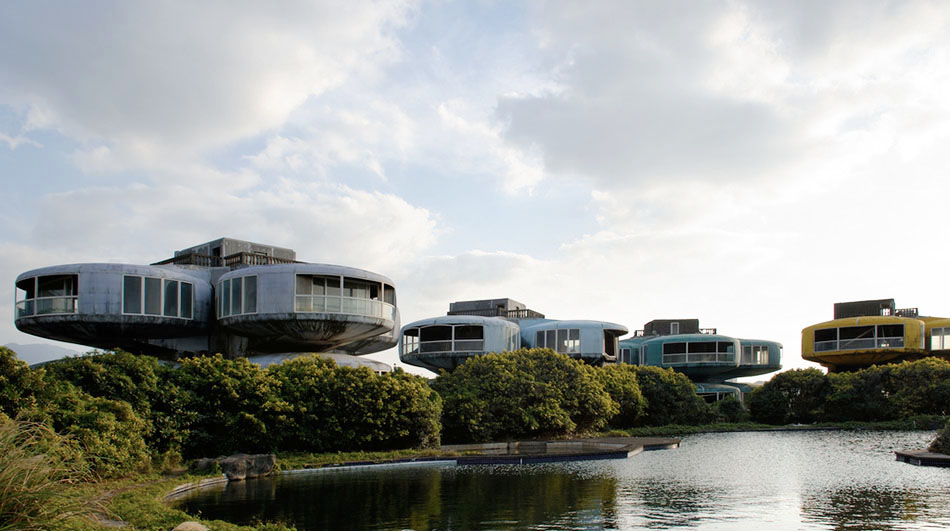
Sanzhi UFO Pod City (Taiwan)
UFO dwellings by the sea? Science fiction writers could set to work immediately. To remain within the realm of non-fiction, however, we shall ‘confine’ ourselves to reality, although with Sanzhi this seems almost impossible.
Sanzhi is a coastal district in north-west Taiwan, an island that sought the protection of the United States in the mid-1950s.16 That American influence brought new opportunities for its tourism industry, such as the development of Sanzhi Pod City (三芝飛碟屋)—a holiday resort intended exclusively for American military personnel stationed in East Asia. At least, that was the plan; yet the futuristic retreat never hosted its first guest. Plagued by fatal accidents and financial setbacks, the developer abandoned the site as early as 1980.
The local population was hardly surprised; according to them, malevolent spirits were at play. By removing a Chinese dragon statue and unearthing a VOC cemetery for 20,000 Dutch soldiers—so the reasoning went—the builders had brought misfortune upon themselves.
Having failed to learn from the past, an investor tried again ten years later, spending 24 million dollars to finish the resort. His approach, too, failed: midway through, the architects discovered that the futuristic design was no match for an earthquake. An uncomfortable sense of déjà vu followed; the builders departed once more, unaware that their unfinished UFO landscape would evolve into a genuine tourist attraction.
Regrettably, this interest could not prevent Pod City from being razed to the ground in 2010. Many Taiwanese regretted the loss; they would have preferred to keep the UFOs as a symbol of the economic resurrection the island experienced in the late seventies.
Where the UFOs eventually went remains a mystery. The site became unavailable for new projects; something the resident dead will not have mourned. Beneath the remaining shrubs, they finally found their rest, and the alleged spirits, a magnificent view of the sea.
Possible perspectives emerging from this subject:
- The layers of foreign influence: How China, the Netherlands (VOC), and America have shaped Taiwan’s identity over the centuries.
- The UFO as a monument: Sanzhi as a symbol of Taiwan’s rapid economic rise and the fragility of futuristic ambitions.
- A cautionary tale: The hubris of developers and the intersection of modern investment with local history and folklore.
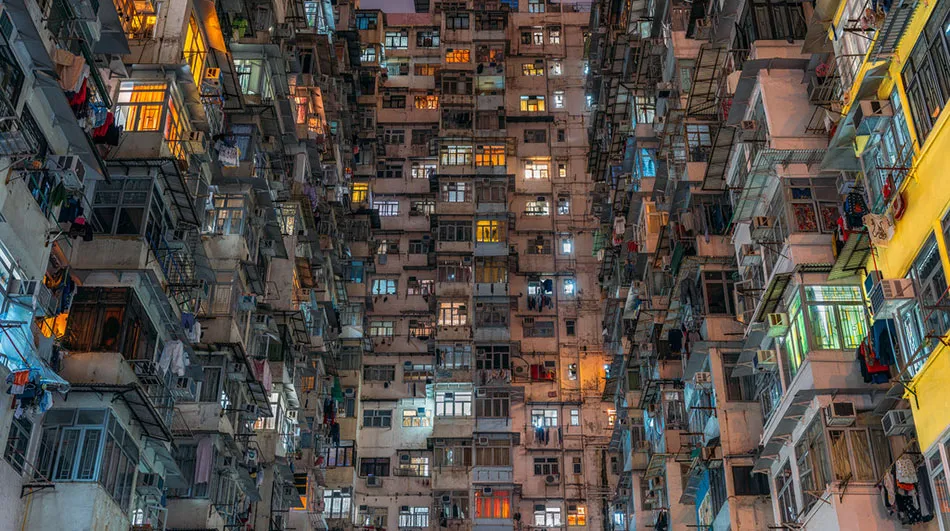
Kowloon Walled City (Hong Kong)
If you are seeing stars now, you may have ventured a little too deep into the shifting vistas of Sanzhi. From those futuristic ruins, we return to a more terrestrial—though no less extraordinary—reality: the walled city of Kowloon. Here, we fortunately remain largely within the boundaries, at least on paper.
Until 1995, the originally Chinese enclave of Kowloon—its name evocatively meaning ‘nine dragons’—lay within the heart of British Hong Kong. In truth, it was a walled anomaly within the wider district. Following the end of the Japanese occupation in the Second World War, the territory was reclaimed by the Chinese, yet for decades it remained a geopolitical ghost; while technically in British hands, the administration remained largely absent. In this vacuum, Triad gangs held sway within the towering walls, a dark reputation that nevertheless failed to deter thousands from making a conscious choice to build a life in Kowloon City.
By the late 1980s, no fewer than 40,000 people lived together in an area covering less than three football pitches.17 It was, as a result, the most densely populated place on earth. Yet this extraordinary density was not its only record. Due to the total absence of formal governance, Kowloon earned the sobriquet ‘lawless city’—the first of its kind in the world. It will come as no surprise, then, that crime flourished: gambling, prostitution, and drugs went hand in hand.
Yet the towering Kowloon did not prove invincible. With the transfer of Hong Kong to China scheduled for 1997, both the Chinese and British governments sought the removal of the walled city. Joining forces, they launched a veritable war on drugs. In a striking paradox, the ground seized in 1856 for the British opium trade became the location for a final, joint war on drugs The towering walls eventually made way for a vacant city park, but the end of the free-state ideal did not signify the end of its legacy. As Hong Kong transitioned to Chinese rule—under a mandate of legislative continuity lasting until 2047—a new kind of ‘enclave’ emerged: a territory that remains, for now, entirely exempt from central Chinese authority.
Perspectives one might consider regarding this subject (particularly in the socio-political sphere):
- The Geopolitical Pivot: Why the Kowloon district was, and remains, so vital to China’s regional influence.
- The Human Dimension: How life persists in a city where daylight hardly penetrates, and the philosophical question of the minimum space a human being requires to exist.
- The Opium Paradox: Why the global trade in narcotics has alternated between being a legal instrument of statecraft and an illegal scourge throughout history.
- Anarchy and Order: Whether Kowloon serves as a definitive case study in human coexistence in the total absence of formal governance or laws.
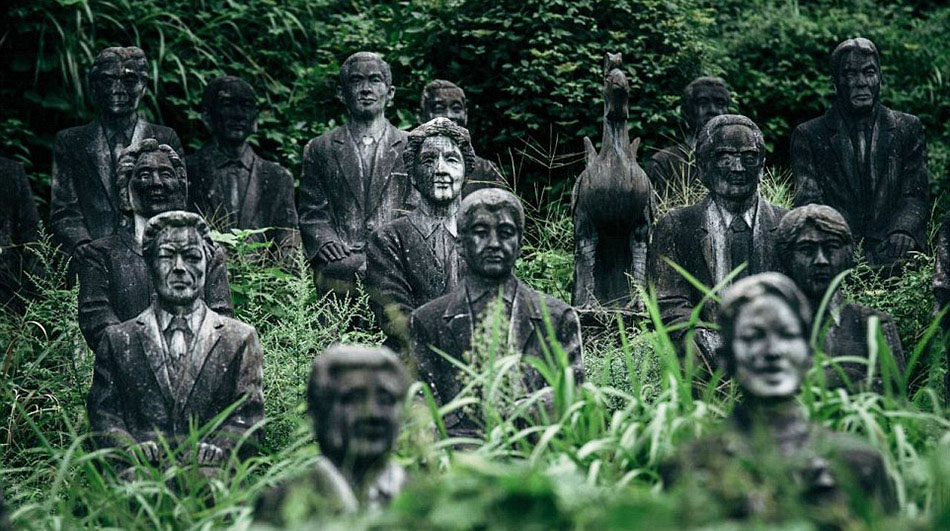
Mutsuo Furukawa (Japan)
Before we depart for the United States, we shall pay a brief visit to the Japanese village of Fureai Sekibutsu no Sato. This translates roughly as 'the village where you can meet Buddhist statues'.
While trekking along the Jinzū River, which flows into the Sea of Japan, a Japanese photographer happened upon a secluded sculpture park in 2016. From a river hill south of the city of Toyama, 800 lifelike statues gazed back at him with curiosity. Three hundred of them represented the family and friends of the late patron, Mutsuo Furukawa, who was himself depicted among them. The remaining 500 Buddhist deities were likely not chosen at random either. According to legend, the bereaved would recognise a deceased loved one in the Buddhist Gohyaku Rakan sculptures, allowing them to meet once more, as it were.
The story brings to mind the town of Hanamaki (Tohoku region) where, some two hundred years ago, 500 Gohyaku Rakan statues were also carved in memory of the famine that struck Tohoku. These statues slowly faded from view as nature clad them in a layer of moss. I do not rule out the possibility that Mutsuo Furukawa was inspired by the priest Gizan of the Daijiji Temple, who carved all those statues in granite at the time.
Mutsuo Furukawa, a native of Toyama, was a prominent businessman who also dedicated himself to improving ties between Japan and China. In 1989, he commissioned the Chinese sculptor Lu Jinqiao18 to produce all these life-sized statues for 44 million dollars. On the one hand, he hoped to keep these likenesses with him forever; on the other, he wished to offer visitors a place of relaxation. Neither wish was fulfilled during his lifetime. After Furukawa passed away at the age of 80, the statues were left behind in desolation, and nature once again partially reclaimed the sculpture park along the Jinzū River.
Fortunately, the rediscovery of this site by the Japanese photographer Ken Ohki has placed the sculpture garden on the tourist map. Thus—depending on one's convictions—at least one noble wish has been granted. Yet the statues are not to everyone's taste. Some passers-by compare the site to a veritable zombie apocalypse. One that unfolded twenty years ago, when all these statues were transported from China across the Jinzū River. There is, however, no accounting for taste, and the 800 statues maintain their silence.
Interesting perspectives that lend themselves to further exploration:
- Life after death: is consciousness bound by place or time?
- The Collective Face: The significance of the Gohyaku Rakan in Japanese culture as a mirror for human individuality within a spiritual crowd.
- A Fragile Bridge: The paradox of the Japan-China relationship: cultural and economic collaboration amidst persistent historical tension.
- Industrial Devotion: The monumental legacy of Lu Jinqiao († 2009) and the ability to maintain individual expression on an almost industrial scale.
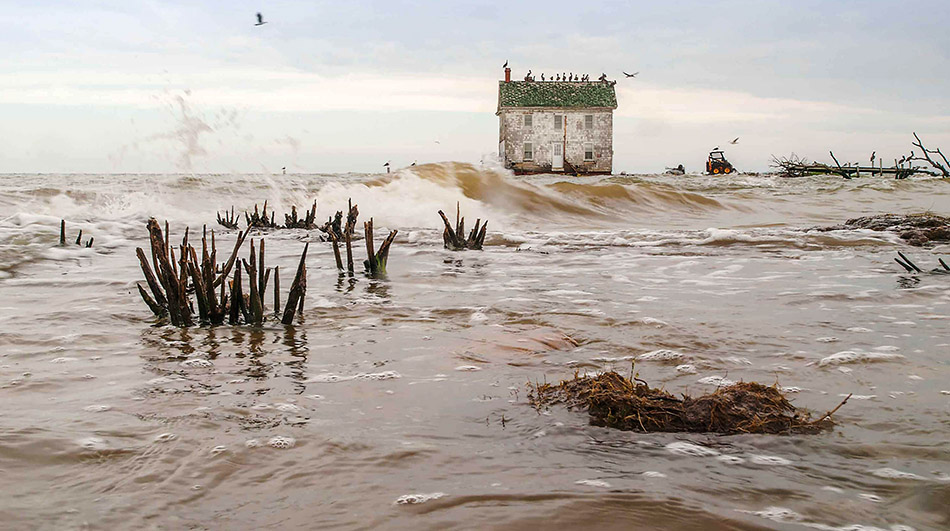
Holland Island (United States)
Our fourth destination is Holland Island, a submerged location off the American East Coast, level with Washington D.C. This former settlement in the Chesapeake Bay sits at the confluence of no fewer than 150 rivers.
Readers interested in American history will undoubtedly be familiar with the historical significance of the Chesapeake Bay. In 1781, it was the backdrop for the Battle of the Chesapeake; a French victory that turned American independence into a reality. Yet that struggle pales in comparison to the ecological battle now gripping the region.19 A silent witness to this defeat is the photograph of the last house on Holland Island, captured moments before it surrendered to the sea.
When the first islanders founded their village around 1600, such an end was likely beyond their imagination. What began as a small cluster of farms and fishing huts grew into a self-sufficient community of over 360 residents. At its peak in 1900, the island was green and fertile, but the prosperity was short-lived. In the years that followed, Holland Island was confronted with a modern crisis: land erosion driven by rising sea levels. The prospect forced residents to dismantle their homes or relocate them by ship to start anew elsewhere.
By 1930, the population had dwindled to zero. Despite the exodus, those with roots buried in the soil refused to give up on Holland Island. They could not, however, count on government aid. A small crew was therefore appointed for its management, but by the end of the last century, only one man remained: Stephen White.20 In a final attempt to save the sinking land, an elderly White purchased the remaining acreage, including the last house. For fifteen years, armed only with sandbags and a small excavator, he tried to turn the tide. But the sea’s patience ran out. On a cool October night in 2010, the waves claimed the last Victorian house, and the village vanished from the map.
The demise of Holland Island is no isolated case. Since 1850, more than 400 islands in Maryland—including the entire Applegarth community—have disappeared in similar fashion. While scientists link this to the Industrial Revolution and CO2 emissions, it seems only a matter of time before the mainland must also brace itself.
Questions and possible perspectives surfacing here:
- Cycles or Crisis: Is the climate merely shifting as it has for millennia, or is the rising sea the result of an unprecedented, human-induced warming?
- The Dyke Paradox: Will the Netherlands continue to raise its defences indefinitely, or is Germany our eventual destination?
- Modern Don Quixotes: A reflection on those who, like Stephen White, take up a solitary, symbolic battle against the inevitable forces of nature.
- The Nomadic Response: The rise of mobile architecture as a pragmatic answer to a world of shifting coastlines and natural threats.
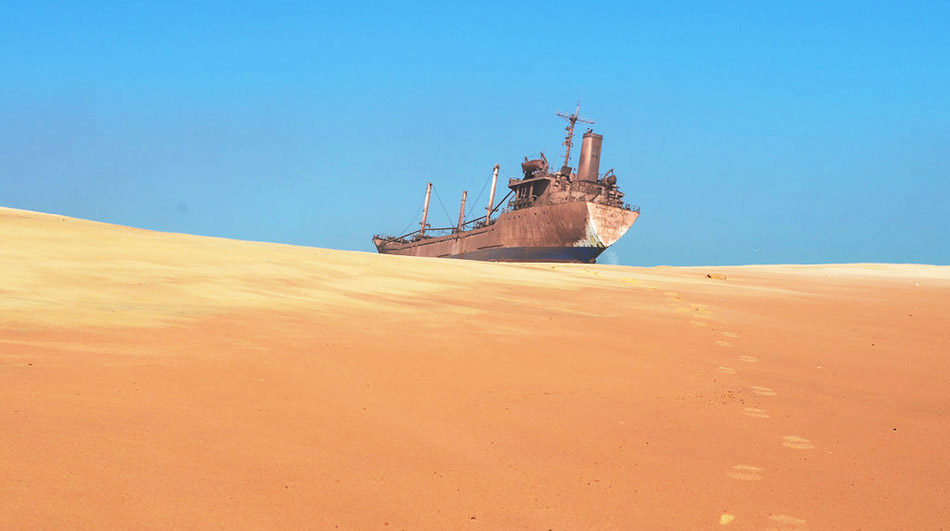
United Malika (North Mauritania)
Sometimes the sea unwillingly yields up its booty once more, as in the case of the United Malika. 'Year of construction: 1979, Status: disappeared', or so the shipping register reads. During its active career, the Japanese-built vessel had several owners. Before it ran aground off the coast of Nouadhibou in 2003 under the Moroccan flag, it had spent most of its time in Dutch hands.
Successive owners had their own 'pet names' for the Malika, which was originally christened Guadalupe. Notable in the registration list is the name Iglo Express.21 A designation given to the ship after it was converted into a reefer by De Groot & van Vliet B.V. in 1995, making the vessel suitable for transporting large shipments of fish. But as so often in history, the fish ultimately came at a high price. En route from Las Palmas to Nouakchott, the ship ran aground on 4 August 2003. Attempts to refloat the seaworthy vessel came to nothing, and it was declared a total loss a year later. Apart from removing the internal oil, no one was willing to salvage the wreck. The stench of the rotting cargo likely played a subordinate role to the political instability in Mauritania.
For those wondering if the ship is still there: the last photograph of the United Malika on the beach dates from May 2014. The 118-metre-long ship was certainly photogenic; as far as I could ascertain, it subsequently fell prey to a local scrapper, or as the shipping register euphemistically puts it: 'disappeared'.
Useful perspectives one might discover here:
- Wabi-sabi: The beauty of the transient and the imperfect; both as a philosophy of life and as a deliberate art form.
- Political Fragility: The uncertain future of Mauritania as a politically unstable nation and its impact on international shipping.
- Flags of Convenience: The remarkable practice of ships sailing alternately under different flags to navigate international law.
- Salvage and Treasure Rights: The scope of maritime rights and the ownership of 'lost' vessels from an international perspective.
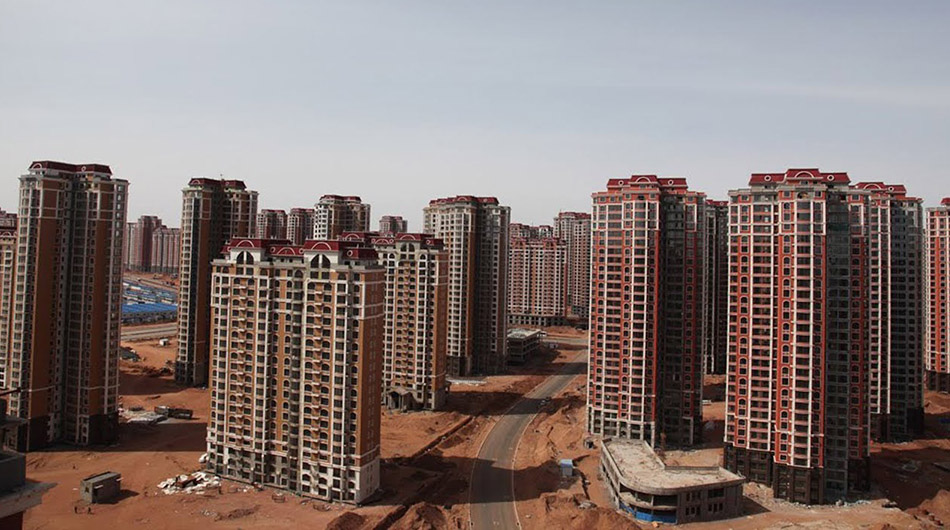
Ordos Kangbashi (People's Republic of China)
We conclude our journey where our story began: Ordos. A district in Inner Mongolia and part of the People's Republic of China. Due to the vast quantities of coal in the ground, the region is often referred to as the 'Texas of China'.
Economically, the old district of Ordos Dongsheng developed so rapidly that expansion became a necessity at the turn of the century. In the face of China's immense wave of urbanisation, the government decided not to do things by halves. With the growth spurt of a Marigold, the new district of Kangbashi rose from the desert, designed to house 300,000 citizens. It is a unique tale that stands in stark contrast to the situation in the Netherlands, where an acute housing shortage has for years stalled the progress of many young people.
China gave no publicity to the project, which was discovered by chance in 2009 by an Al Jazeera journalist.22 While construction was still in full swing, the news of a 'deserted Utopia' was broadcast to the world. High property taxes and poor construction were said to have turned the metropolis into a ghost city. The local government also faced criticism, accused of building an empty city merely to artificially stimulate the Gross Domestic Product.23
In the following years, this narrative set the tone for hundreds of journalists worldwide who adopted it without question. The fact that the influx of residents had already begun in 2012, and that 150,000 people were living there by 2015, went entirely unnoticed.
By now, the green city of Ordos has almost completely filled up; the myth of the ghost city can be dismissed as 'fake news'. Ordos is the story of the prefab metropolis—a new phenomenon from which the West could still learn, provided we search with sincerity and do not base our worldview solely on Google.
Perspectives one might build upon:
- The Digital Erosion of Truth: To what extent the internet and 'speed-journalism' have compromised the quality and sincerity of global reporting.
- The Prefab Metropolis: The planned city as a pragmatic response to a rapidly growing global population.
- Urban Gravitation: The mass migration of workers and youth to cities and its impact on the rural heartland.
- The Fossil Fuel Paradox: The tension between the economic necessity of coal and the urgent demand for green, sustainable energy.