


- 63. For those wishing to explore further works within the conceptual fiction genre, I recommend the writings of Richard Kostelanetz (Three Poems, 2011), Kurt Vonnegut Jr. (Cat’s Cradle, 1963 / Slaughterhouse-Five, 1969), Georgi Gospodinov (Time Shelter, 2020), or Margaret Atwood (The Handmaid's Tale, 1985). Conceptual Fiction remains a difficult concept to define, as its execution varies per narrative; consequently, identifying works within this genre is far from straightforward. A practical point of departure is the umbrella term Speculative Fiction.↩
- 64. Stephenson, N. (1992). Snow Crash, Bantam Books.↩
- 65. Corbett, S. (2009, 5 March). Portrait of an Artist as an Avatar. The New York Times.↩
- 66. A simple 3D miniature version (Collada) of the railcar, also suitable for Three.js web animations, can be found here. At the time, creations were saved in the OXP format—an XML-like file format that is no longer supported.↩
- 67. MMO(G) stands for Massively Multiplayer Online (Game). In these virtual environments, thousands of individuals can interact simultaneously. Whilst an MMO can be a constituent part of a Metaverse, these open worlds are not identical. Unlike a Metaverse, an MMO typically features a clearly defined plot and predefined objectives to be achieved within the parameters of the story (concept).↩
- 68. Wiehager, R. (2009). Charlotte Posenenske: The Same but Different / Dasselbe anders. Walther König.↩
- 69. Compare also: Dworkin, C., & Goldsmith, K. (Eds.). (2011). Against Expression: An Anthology of Conceptual Writing. Northwestern University Press.↩
- 70. Goldsmith, K. (2001). Soliloquy, Granary Books. Preceded by a wall art installation in 1997 – Bravin Post Lee (New York).↩
- 71. Joyce, J. (1939). Finnegans Wake. Viking Press. 1939 was the year the complete version was published.↩
- 72. See also: On Kawara, (1981, 20 May). (“Wednesday”). New York. From Today, 1966–2013. [Private collection]. © On Kawara. Photo link: David Zwirner, New York/London. Museum: Guggenheim Museum.↩
“Writing is a shifting vista; each story shapes new contours, redrawing the path ahead."
CONCEPTUAL FICTION
A New Horizon
Category: Writing
| Tuesday, 17 August 2021 (updated 5 Sept 2021)In 2019, I wrote about the commonalities and distinctions between fiction, non-fiction, and creative non-fiction. To this trio, I could have added a fourth genre: that of conceptual fiction.63 At the time, I chose not to, for fear of causing confusion. In the Netherlands, conceptual fiction lacks a clearly defined place among established genres; indeed, the concept remains an outlier in our region.
I have been grappling with the term for some time, as it touches upon the narrative concepts I am currently developing. In A New Horizon—as we approach the conclusion of this volume—we shall delve deeper into the matter.
What is Conceptual Fiction?
Whilst the rules governing other genres have been established for decades, the same cannot be said for conceptual fiction. Literary critics and authors have yet to fully define its palette. This is remarkable, given that the conceptual movement has existed in art for over half a century. In part, this lack of definition stems from pedantry—an approach that conceptual fiction and art specifically seek to avoid. In conceptual fiction, the laws of nature and ingrained conventions are not limits to be obeyed; rather, the author defines their own boundaries. Yet, this freedom does not instantly transform conceptual fiction into (speculative) science fiction. A key characteristic of conceptual fiction is that it plays upon our preconceived notions of reality, without being beholden to them.
But conceptual fiction reaches further. Unlike standard fiction, conceptual fiction accords far more weight to the concept than to its execution. And for the sake of clarity: when we speak of conceptual fiction, we are referring to conceptual writing. It is a style that precisely seeks not to be a style, for in conceptual writing, contemplating the idea of the work is more important than the reading itself. This philosophy finds its mirror image in conceptual art—at least, for those who substitute the term 'viewing' for 'reading'. But is such a distinction still relevant?
Conceptual writers and artists share a focus on ideas and concepts. They draw their audience into a concept that prompts reflection and a reappraisal of ingrained conventions. Aesthetics and form are of secondary importance. It goes without saying that this also places greater demands upon the viewing and reading public; a passive, merely receptive role is not an option.
Whilst the aforementioned provides some structure to the perception of the conceptual aspect, this knowledge pushes us into a rather difficult position—not least because I have taken the liberty of blending conceptual art and conceptual writing into a single hue. The primary reason for this is that art and literary forms have converged significantly in recent years; so much so that a sharp distinction is no longer justified. I shall illustrate this through my experiences with a relatively nascent art form: modular virtual art.
The Metaverse
Between 2006 and 2010, modular virtual art experienced a significant surge. It is termed 'modular' because objects within a 3D environment could be constructed from so-called 'primitives'—small building blocks that users could sculpt and combine into almost any conceivable shape and colour. This interactive application was made possible by Linden Lab’s revolutionary—and Emmy Award winning—Massively Multiplayer Metaverse. Suddenly, art was brought within reach of the masses: a dream for any conceptualist. But it was the realisation of a dream in another sense too, as fiction suddenly became reality.
Ball State was among the many universities that actively participated in that Metaverse—an environment where major corporations such as Intel, Nike, BBC Film Network, IBM, and Kelly Services were also represented.
Linden Lab, an American company with clear roots in the Burning Man scene, had dared to model its Metaverse after the example in Neal Stephenson’s Snow Crash (1992).64 In this novel, the author describes life as an avatar in a virtual, shared world: the Metaverse. Parts of that incarnate Metaverse, inhabited by millions of active users, were leased by Linden Lab to corporations and institutions such as the Institute for Digital Intermedia Arts (IDIA Laboratories)—a scientific research centre for the arts at Ball State University. Ball State was among the many universities that actively participated in that Metaverse, an environment where major corporations such as Intel, Nike, BBC Film Network, IBM, and Kelly Services were also represented. What made IDIA particularly compelling was that they did not merely conduct research, but also provided support for art projects, such as those by the American artist AM Radio (Jeff Berg). His vistas, with their unmistakable 1930s and 40s aesthetic, left a significant mark on the transition from offline to online art.
When I first encountered AM Radio in 2009, I did not yet realise — despite a broad interest in art — that his work possessed many characteristics of what we would now consider conceptual art or fiction. Nor was I aware that his actual name was Jeff Berg—a name he meticulously shielded from the media until recently. Jeff did not seek fame; not even when the New York Times approached him in 2009.65 In fact, as an artist, AM Radio preferred that no reviews or photographs of his work exist outside the Metaverse. He found it disconcerting that others might experience and interpret his work differently than he did himself; he was reluctant to grant the public that space for imaginative interpretation.
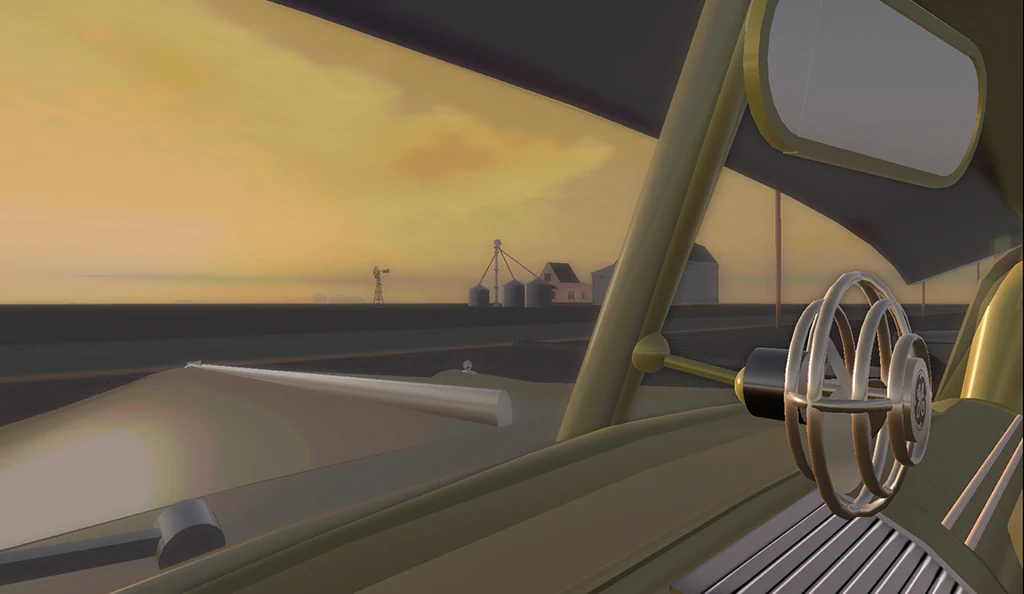
AM Radio's The Refuge and the Expansion (2008)Photo: Rowan Wilcher
A decade on, I recognise that it was precisely that sense of space which rendered his work so exceptional, for AM Radio crafted purely (fictional) concepts. Insofar as the concept conveyed a narrative, it was, in truth, secondary. The moment a visitor entered the virtual exhibition, they became an intrinsic part of his environment. An artistic display wherein one could—individually or collectively—temporarily introduce objects and engage in interactions. For every visitor, within AM Radio’s predefined framework, the experience was distinct. And these concepts provoked enquiry. For what purpose does a sewing machine, with an immensely long, billowing fabric beneath its needle, sit in the midst of a 65,536 m² salt flat? Or consider a staircase with a door situated in the middle of the sea? These were elements encountered by visitors in Superdyne (2008) and The Red and the Wild (2009), respectively.
Whilst AM Radio meticulously contemplated the contours of his vistas and the arrangement of detailed objects, the overarching experience unfolded within that which he had left undefined. He merely established the 'conditions' for it. He drew inspiration for his concepts from nineteenth-century Transcendentalism (the primacy of intuition over empiricism) and pre-war American Realism, which he romanticised with elements evocative of scenes from the film Days of Heaven (1978). Occasionally, previously utilised objects would reappear in the setting of a new work, thereby acquiring a shifted significance. The now-iconic steam locomotive serves as a case in point. Initially, this wreckage functioned as a symbol of hope and enchantment amongst the wheat fields of The Quiet and the Far Away (2007). In The Refuge and the Expansion (2008), however, it occupied a passive, supporting role, before finally emerging—restored—as a beacon of strength and creativity in The Red and the Wild (2009).
For those who struggled with the more whimsical aspects—where, for instance, touching a dragonfly might trigger the appearance of a series of floating chairs—there was always a mode of transport to serve as a tangible link to reality. Exhibitions lacking the prominent presence of a boat, train, motorcar, or aircraft were rare indeed. The invitation to movement within the retrospective dimension was a recurring motif throughout his entire oeuvre.
Should one desire to strip AM Radio's work of its conceptual dimension to translate his creations into tangible styles of the offline world, I suspect one would arrive somewhere between the Gray and Gold (1942) of John Rogers Cox and Christina's World (1948) by the American painter Andrew Wyeth. One also finds unmistakably minimalist elements and that sense of profound solitude characteristic of the realist Edward Hopper, as seen in his work Gas (1940).
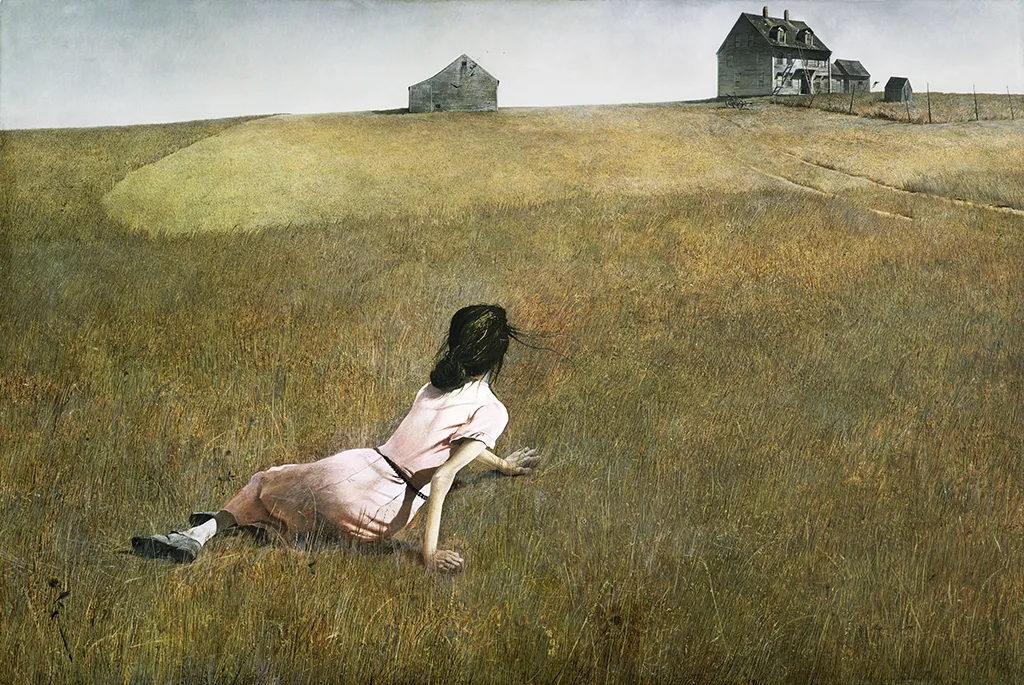
Christina's World, 1948 — Andrew Wyeth.
A Personal Evolution
During the same period (2009–2011), I experimented on a more modest scale with techniques wherein tints, layers, and luminescence played a prominent role, often pared back to their absolute essence. Beyond the concepts themselves—some of which were accessible via the virtual Campus d'Art (2009–2013)—there was nothing more. There was an illusion, certainly, but no narrative. For me personally, this became a broader evolution, in which I began to experiment with structures, spatiality, and text. To certain interactive objects, I integrated spatial narrative elements. In doing so, I frequently sought an anthropomorphic approach, as demonstrated in The Wanderer: an immersive environment in which the visitor could lose themselves within a vast nocturnal setting. The lighting was so composed that a series of long, diagonal shadows fell across the path like the stripes of a pinstripe suit.
One day I found myself wandering through enchanting forests and forgotten places, the wind gently blowing through my hair, until the light slowly gave way to the placid dark night.
On my way back, accompanied by shadows and a willing moon, we played hide and seek behind the trunks along a tree-canopied, deserted road.
It was the rustling of leaves, by an invisible breeze, that finally gave me away. The moon softly whispered: "The sun will come, we cannot stay."
On my way back, accompanied by shadows and a willing moon, we played hide and seek behind the trunks along a tree-canopied, deserted road.
It was the rustling of leaves, by an invisible breeze, that finally gave me away. The moon softly whispered: "The sun will come, we cannot stay."
The Wanderer, third passage (2009)© Rowan Wilcher
I abandoned chronological order there, as I had no influence — nor did I wish to have any — over the viewer’s visual and physical trajectory. That agency rested with the viewers themselves. Returning visitors intrigued me the most. Sometimes they sat for hours in their favourite spot, and I wondered what they were thinking in those dark voids of the third watch of the night. It was their interpretation of my concept.
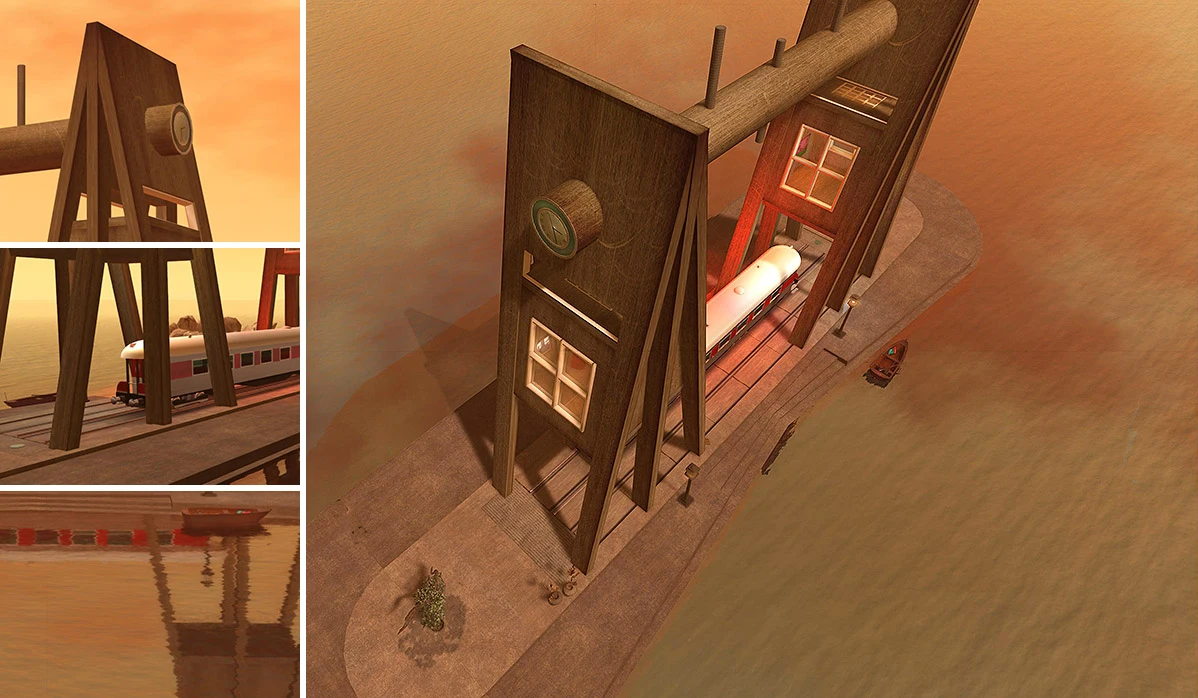
Nostalgia (2011) © Rowan Wilcher
Nostalgia marked my final immersive virtual exploration. The railway carriage—which evoked a sense of both the surreal and the nostalgic—was a nod to the oeuvre of AM Radio, who never produced a passenger compartment.66 The creation of a virtual environment and the subsequent human experience fascinated me immeasurably. Text, image, animation, and interaction coalesced seamlessly. Nonetheless, the fabrication of every object was a formidable and time-consuming undertaking, and such a concept could not be physically traded. And no, the non-fungible token for virtual works did not, alas, yet exist—but that is an aside. Emboldened by this broadening of my horizons, I resolved to look further afield, a decision that proved to be the correct one.
Modular art within the Metaverse did not, in the end, secure the future it merited and for which many had hoped. Further development would, by definition, have been futile. Not only did Linden Lab’s monopoly preclude an interoperable industry standard, but the economic crisis also began to take its toll. Thus, in 2011, IDIA, which provided server capacity for AM Radio, departed the Metaverse. They were followed shortly thereafter by AM Radio himself, who returned to the disciplines of painting and writing. His departure poignantly illustrated the inherent vulnerability and transitional nature of the virtual art form. With the stroke of a key, nearly his entire oeuvre—including Superdyne, The Quiet, The Ferry, and The Refuge and the Expansion—was irrevocably lost.
For myself, new paths emerged after 2012. Nonetheless, the experience garnered proved invaluable when, in 2019, I commenced the conceptualisation and elaboration of broader narrative frameworks. It was a difficult choice, as I had just completed a non-fiction volume and the blueprint for its successor was already prepared. But writing is a shifting vista; each story shapes new contours, redrawing the path ahead. The conceptual aspect began to weigh increasingly heavily on me, and consequently, non-fiction gradually receded into the background.
Literary critics place great store by the verisimilitude of fiction. Works that fall short are promptly categorised as sci-fi or fantasy.
Writing within this new setting felt like learning to walk anew. I frequently reflected upon the latitude afforded by the newly chosen domain, and the demands I ought to impose upon myself when drafting these concepts. That process is not yet entirely concluded, but such searching is an essential part of the endeavour.
The Conception of Ideas
In the mid-2010s, we still perceived the virtual world as a discrete, autonomous entity. Over a decade later, the two have become almost entirely interwoven. Over half a billion young people spend their leisure time as avatars in MMOs such as Fortnite and Roblox, both of which have recently begun developing their own Metaverses.67 This transition has, in my estimation, imparted a new dimension to the perception of reality. Consider the application of Virtual Reality Headsets in the medical field: the operative gestures a surgeon sketches in empty space are translated and rendered tangible by a surgical robot performing an operation on a patient elsewhere in the world. This defies our conventional notions of reality, yet it is an integral part of that very same reality—or rather, an extended reality.
Returning to the premise of this article, the question naturally arises as to why conceptual fiction should not simply pass as fiction. After all, fiction need not be factual. However, whether something is factual is distinct from whether it is perceived as realistic. Literary critics place great store by the verisimilitude of fiction. Works that fall short are promptly categorised as sci-fi or fantasy. Occasionally, this distinction is made for purely commercial reasons. Yet the question remains as to the raison d'être of conceptual fiction within the spectrum of genres. To find an answer, we must return to the (offline) art sector of the 1960s. It is in that world that we first encounter the conceptual (fiction) movement.
Art of the Mind
Around 1965, a movement began to coalesce in opposition to the established art world, which it viewed as profoundly commercialised. The profit motives of galleries had pushed the social relevance of art into the background. In this new movement, the material or the outward form was no longer central; instead, the emphasis shifted to the preceding intellectual processes. Conceptual art may therefore be regarded as art of the (immaterial) mind. Furthermore, the 'end result' no longer required a sense of completion or finish, as is expected of a painting or sculpture. Naturally, this unsettled the commercial art world, as such works could not be easily commodified, nor did they require a formal gallery setting for viewing. One need only consider the practical impediments inherent in a work of art created in the midst of nature, such as Charlotte Posenenske’s 1967 Vierkantrohre Serie D.
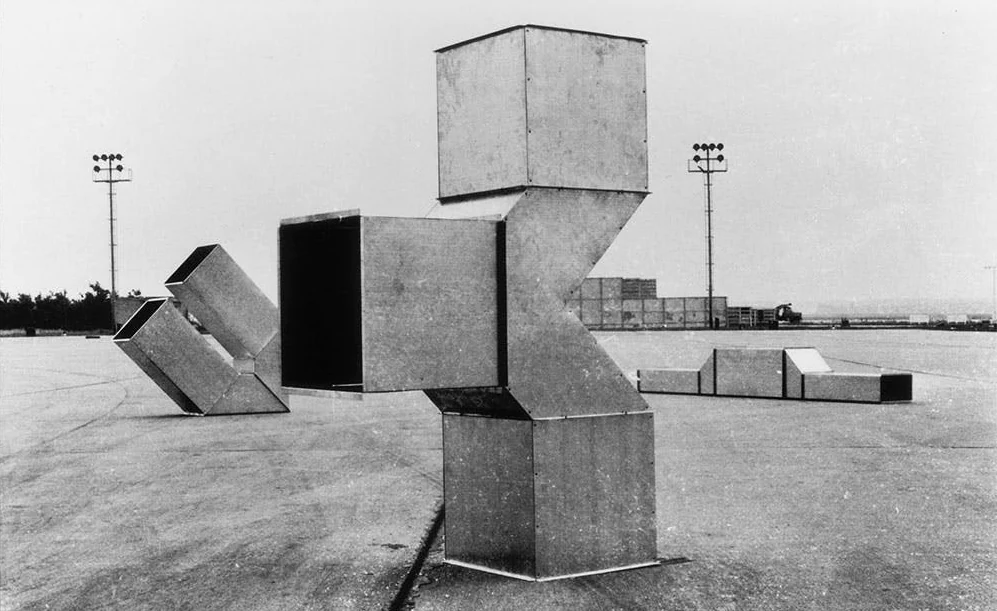
Charlotte Posenenske, Vierkantrohre Serie D 1967, Frankfurt. © Estate of C. Posenenske
The components, which appeared to have been salvaged directly from an industrial ventilation shaft, were modular and capable of expansion according to the exigencies of the environment. This is reminiscent of the modular 'prims' within the aforementioned Metaverse.
It is noteworthy that Posenenske left the reuse of the components from her entire Vierkantrohre Series A to D entirely unregulated. From a copyright perspective, this was profoundly unorthodox. By doing so, she provided the latitude for her work to be reconstructed elsewhere in a different configuration; a condition that Posenenske regarded as sacrosanct. In her estimation, it was imperative that the public (whom she also termed 'consumers') felt invited to play with her concept and to introduce their own modifications. Yet, this was an unmonetised endeavour. Consequently, her art did not find a home in expensive galleries but was instead sold at cost price.
Despite the fact that Posenenske’s Vierkantrohre (1967) and Drehflügel (1968) Series represented her most successful creations, she abruptly ceased her practice as a conceptual artist to study industrial sociology. This departure was in no way precipitated by a lack of income. Rather, Posenenske withdrew because of a conviction that art was incapable of dismantling extant social inequalities.68 She thus resolved to devote herself to the improvement of employment opportunities and industrial labour methods, eschewing art exhibitions from that point forward.
The conceptual art form itself reached its zenith during the mid-1970s, having long extricated itself from mainstream artistic culture. This success was intrinsically linked to the freedom inherent in the artistic expression. The conceptual fiction artist could simply requisition any materials or techniques that best conveyed their message. This included (or combined) photography, video, and the written word.
Conceptual Poetry
Partially divested of the notion that the art world must remain non-commercial, the movement gradually found a new path during the 1980s as an art form that could be accommodated within commercial art culture. Nevertheless, the movement did not immediately secure an entry into the literary world, with its rigidly defined genres. It was not until 2003 that the term 'conceptual writing' was first employed in this context by Craig Dworkin and Kenneth Goldsmith.69 Both poets questioned what non-expressive poetry might look like if it were a poetry of intellect, rather than affect.
This took form in the work of Kenneth Goldsmith through the encapsulation of a newspaper within a poem (Day, 2003) or the recording of every word he uttered over the course of a week into a poem (Soliloquy, 1997).70 In these works, Kenneth sought a form that could be perceived as machinic, and which was never intended to be read in its entirety. Style was thus subordinate to the overarching idea: the creation of 'non-original poetry' that could nevertheless be categorised as poetry by literary critics.
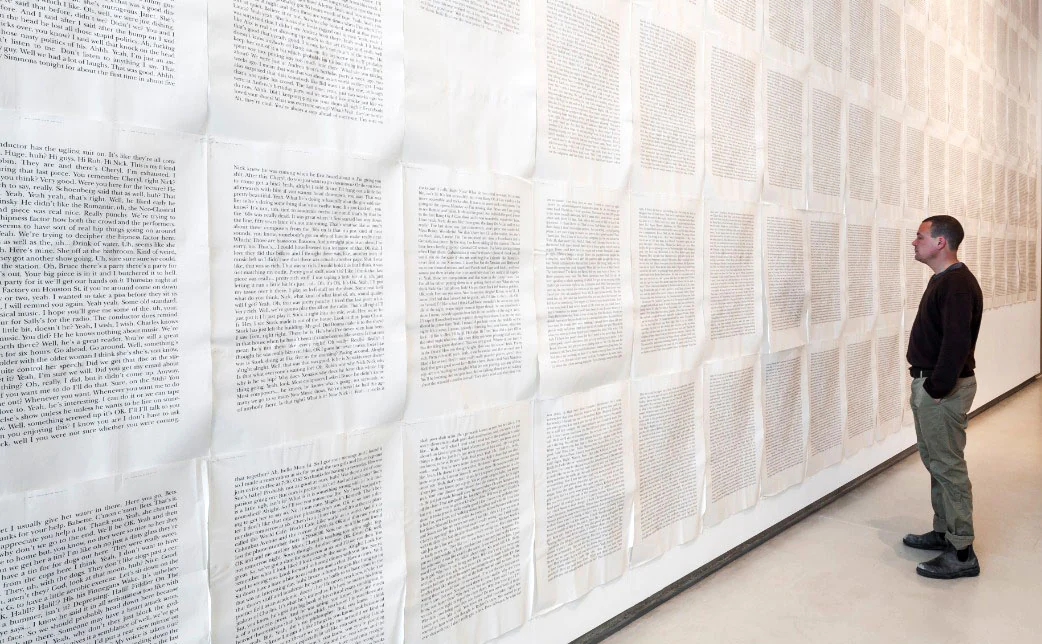
Kenneth Goldsmith – Soliloquy (1997), Bravin Post Lee (New York).Photo: Kenneth Goldsmith
The conceptuality of Goldsmith’s earliest works (Soliloquy and Fidget (1997)) resided, to my mind, in the invitation—or rather, the gentle ‘coercion’—to seek out passages of interest. Take Soliloquy, for instance, a variation upon Hamlet’s eponymous monologue. Initially, this work was transcribed in loose-leaf form across four vast gallery walls (visual art). In 2001, Soliloquy appeared in book form (literature). By binding these loose leaves into a codex (a commercial exigency), the modular character was, in my view, irrevocably lost. The same held true for the choice of the internet variant that emerged several years later. For this medium, the work’s typography was specifically recalibrated. Although the digital version at the time imposed demands upon one’s choice of browser, it served as an excellent instrument for navigating towards more readable passages. In Goldsmith’s subsequent works, such as The Weather (2005) and Sports (2009), readership appears no longer to be the objective.
Of far greater consequence, however, is that the example of Kenneth’s Soliloquy vividly demonstrates how conceptual art and conceptual writing may entirely converge. This is a phenomenon we also witnessed within the Metaverse, where the distinction between these forms proved equally futile.
Conceptual Fiction Observed Anew
Having refined our understanding of how art and poetry inhabit the conceptual dimension, and how reading and viewing (within the Metaverse) may wholly coalesce—even far beyond the pictorial narrative—we slowly merge back onto the motorway toward conceptual fiction. And looking in the rear-view mirror, we see that art and poetry have developed at a swifter pace over recent years than the literary world at large. This is especially true in the light of digital advancements.
Why is this Metaverse, under which we may also subsume the internet, so vital in this context? The answer lies in the unprecedented volume of digital data projected onto our retinas through these media. Information that can assume any conceivable form. There, writing, reading, and viewing unfold according to processes distinct from those we have traditionally distinguished. Not only is the dividing line one that now exists solely on paper, but assimilation also engenders a surfeit of informational stimuli. To delineate or define the fiction component using only classical conceptions may no longer suffice. The new reality demands a reappraisal, wherein we must also question the extent to which fiction can accommodate the conceptual, and in what form they might (or can) coalesce. The outcome of this reappraisal must, however, remain applicable to the offline world; otherwise, conceptual fiction would be, by definition, a Metaversal fiction. The latter should primarily be regarded as the shifting horizon when discussing the manifestation of conceptual fiction. This shifting vista nonetheless finds its own finite horizon in the knowledge that while all may be poetry, not all can be fiction. In that knowledge, let us venture forth with a genuine fictional concept.
The Bookshelf Experiment: Deceptions in Terminis
For this fictional concept, we select a random shelf within the library’s fiction department and retrieve a comprehensive list of its titles. This allows us to tether the collection to the digital realm. The conceptual work we intend to compose—let us entitle it Deceptions in Terminis (DIT)—shall encompass the contents of all five hundred volumes upon that shelf. Online research swiftly reveals that the oldest tome dates from 1792, while the most recent was published in 2021. Such a span of nearly two and a half centuries guarantees a shifting perspective. To grasp the true magnitude: the average edition runs to four hundred pages, bringing the total to some two hundred thousand. This equates to five thousand hours of reading—more than a year of continuous study.
For the purpose of the concept, these disparate narratives and elaborate emotional arcs are, with one singular exception, largely irrelevant. Our work concerns a profoundly banal subject: mendacity. Even though these works of fiction are realistic and populated by authentic characters, some personae are capable of lying with practised ease. Utilising a bespoke algorithm, crafted specifically for this project, we distil these untruths from the text. We distinguish between falsehoods uttered by male characters and those originating from the female. The result is a staggering tally of nearly three thousand blatant lies, ranging from the 'white lie' of convenience to those born of avarice or self-preservation. These are fabrications voiced or unmasked within realistic settings—fictions that steered, or indeed dictated, the very course of the stories from which they were plucked.
To construct the conceptual manuscript, we subsequently arrange these lies by theme and approximate date, allowing for a broad margin of some twenty-five years. The deceptive dialogues are then cast into a new narrative, in which every male lie—preserved in chronological order—alternates with a female counterpart. The result is striking: exquisite dialogues, steeped in centuries of deceit. At times, the text is perfectly lucid; elsewhere, passages seem to coalesce by sheer, fortuitous coincidence. Frequently, however, it remains impenetrable, however technically precise. Nevertheless, the work piques the reader's curiosity; through their newfound positioning, certain lies suddenly acquire an air of credibility.
But how is this to be experienced? The reader is compelled to navigate the text, uncovering connections, perceived patterns, and—above all—chaos. They become acutely conscious of the singular role mendacity plays within a realistic context. The method and the underlying idea force the reader to think; the concept has become paramount to the form. Stripped of sentiment, Deceptions in Terminis is primarily a work of intellectual inquiry: the narrative itself is secondary to the reader’s contemplation of the concept. For no matter how one positions or presents a lie, in any context, it inevitably sows confusion. Yet, one form renders this far more visible than another.
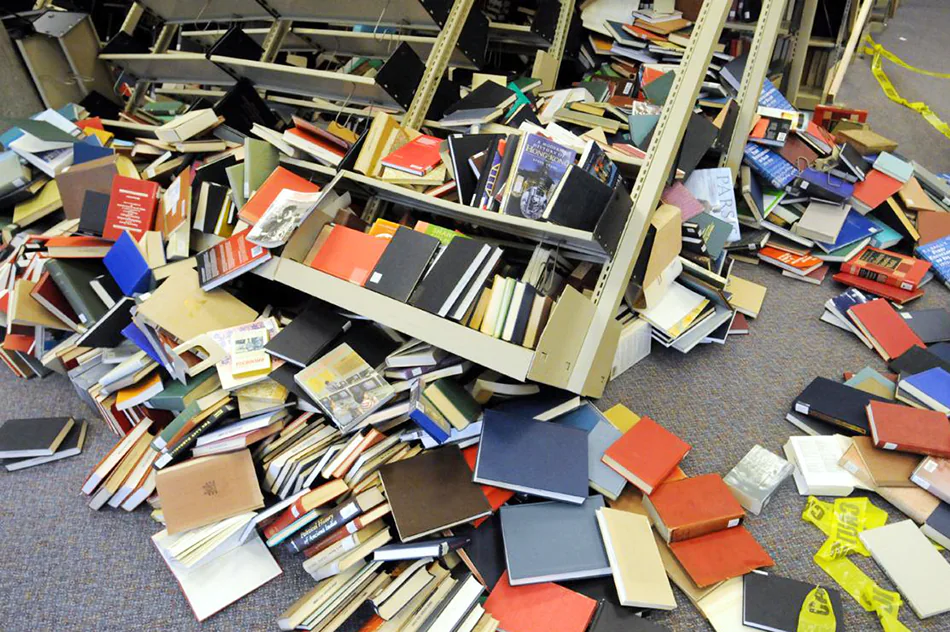
It is also possible to miss the mark with a conceptual approach.Photo: Indiana State University
Latitude
Our volume, Deceptions in Terminis, serves as a concrete manifestation of what a contemporary conceptual work of fiction might entail. That result offers sufficient scope to examine the additional latitude we possess within this genre.
As previously observed, in conceptual writing, form remains subordinate to the concept. Kenneth Goldsmith noted, regarding his conceptual poetry, that the reader need not engage in the act of reading at all. However, this does not preclude one from manipulating that form. Further on, I shall elucidate why it is imperative in conceptual writing to maintain a distinction between fiction and poetry.
Concentrating once more upon Deceptions in Terminis, we could, for instance, modulate the execution of various passages. To a certain degree, we might interweave them in a more legible fashion. As an author, one may experiment with such techniques, cognizant of the fact that no absolute minimum or maximum threshold has been formulated for such a task. When form begins to predominate over the concept—and the idea becomes subservient to the aesthetic—I believe the maximum limit has been transgressed. At that juncture, we find ourselves entering a disparate genre.
Regarding the accessibility of the content, it is vital to relinquish the classical method of reading. Should we wish to release this work in digital form, it would be prudent to return to the drawing board. The content, naturally, remains immutable, but devising a reading key would be a valuable undertaking. A functionality through which the work can be more readily accessed and its dynamism enhanced—for example, by facilitating the visible linkage of passages to their provenance. Naturally, a compelling copyright challenge lurks around the corner. Within the remit of this article, it would be a digression to delve deeper into that matter, but it is worth bearing in mind.
Defining the Fiction
Whilst the preceding example provides a clear insight into the conceptual fiction landscape, it does not yet encompass the entirety of the genre. Where we must seek greater breadth is within the fictional element itself. As we have seen earlier, the 'regular' fiction genre is characterised by several literary qualities that impart value to a book—for instance, because the narrative addresses something more profound than a mere tale. One might consider a story that serves as a commentary upon significant social, societal, or political exigencies. The characters and their settings are indeed fictional, yet they may be informed by real life, authentic individuals, and actual events. The author zo enjoys considerable creative prerogative, but a steadfast requirement is that it remains grounded in realism. To what extent conceptual fiction must satisfy this requirement of verisimilitude, without exhibiting overlap with an adjacent sub-genre, is more difficult to adjudicate.
Proceeding from the premise that the concept prevails and that conceptual fiction does not submit to extant conventions or laws of nature, but rather seeks to exploit them, this must in principle be the guiding factor. Form must not become the decisive arbiter. I emphasise decisive, because in fiction—far more so than in poetry—form invariably occupies a certain role in the background. The concept articulates itself through form, yet that role is circumscribed. For regardless of one's perspective, the concept must be afforded sufficient scope to play with reality without being immediately relegated to another genre. From that vantage point, there is a case to be made for situating certain works by the science fiction writer Asimov within the conceptual fiction genre. In his book Runaround (1942), for example, Asimov formulates the blueprint for the three laws of robotics. In the 1940s, this concept was still divorced from all reality, but the passage of time has altered that. His concept now serves as a foundation and point of departure for corporations and governments when regulating and contemplating the artificial brain.
That a work migrates between genres is, incidentally, not exceptional. We witnessed this with Finnegans Wake (1939) by the Irish writer James Joyce.71 A book that—with the benefit of hindsight—may be regarded as conceptual fiction.
The interplay between concept and form—and thus the process of conceptual writing—can be far more intimate than Goldsmith would have us believe.
Finnegans Wake chronicles a single day in the life of the publican Humphrey Earwicker and his kin, wherein the perception of reality is predominantly mediated through a dreamscape. For the narrative, Joyce employs a bespoke methodology to recreate the somnolent experience—or rather, a delirium—manifested through the fluid coalescence of concepts, personae, and topographies within the subconscious. To this end, Joyce utilised linguistic structures and nomenclature that were—most certainly for that era—profoundly unorthodox.
By virtue of the myriad linguistic conceits and latent significations embedded within his prose, Joyce set a formidable threshold for the reader. He frequently amalgamated morphemes from disparate terms to forge neologisms. Yet, the creative locus of the concept resides elsewhere; Finnegans Wake primarily demonstrates the perpetual recurrence of history. This is articulated by commencing the narrative mid-sentence and concluding with the initial fragment—omitted at the outset—of that very same sentence.
[Beginning ...] riverrun, past Eve and Adam's, from swerve of short to bend of bay, brings us by a commodious vicus of recirculation back to Howth Castle and Environs."
"A way a lone a last a loved a long the [... End]
In the 1940s, many were not yet predisposed to such innovation, yet we have since come to appreciate the full weight of his intellection. The principal insight to be gleaned from Finnegans Wake is the potential configuration of the fictional component—the story—within a conceptual framework: an original narrative that maintains its status as a genuine work of fiction.
Towards which provisional horizon does this lead us?
It will, by now, have become evident that conceptual writing is inherently experimental. Conceptual fiction is, for the contemporary author, a genre par excellence that aligns with the possibilities of a new era: an age in which text may assume any conceivable—and as yet inconceivable—form, provided it remains ancillary to the concept or idea that interrogates our conventional reality. Within conceptual writing, a distinction must be maintained between poetry and fiction, as delineated in Table 2 below.
| Fiction | Conceptual Poetry | Conceptual Fiction |
|---|---|---|
| Realistically untrue | Open interpretation (selection) | (Un)realistically untrue |
| Narrative and form prevailing | Form as mechanical consequence of concept | Form subordinate to concept |
| Dialogue (characters) | Free association | Dialogue (manipulates text) |
| Invites readership | Intellection; reading difficult/non-essential | Intellection; reading necessitates reflection |
| Emotion/empathy | Reason over emotion | Scope for emotion |
| Conventionality as guiding principle | May play with conventions | Interrogates conventions and/or laws of nature |
Unlike Kenneth Goldsmith, I contend that within conceptual writing, form possesses greater intrinsic value than merely serving as a mechanical derivative of a preexisting creative impulse. The interplay between concept and form—and thus the very process of conceptual writing—can be far more intimate than Goldsmith would have us believe. To witness this, one need only look to Finnegans Wake. In this work, the concept relies profoundly upon—and extends across—a creative play with text. We see this similarly in the works of Richard Kostelanetz, who deliberately explores the boundaries of the genre. Goldsmith places his emphasis almost entirely upon the intellect, yet this is largely for effect. Within conceptual art, there has been a steady departure over the years from the notion that conceptual expressions ought to be devoid of emotion. Consider, for instance, the postal works of the late conceptual artist On Kawara. Kawara's conceptual, language-based expressions were manifested through data on postcards, telegrams, and paintings—a chronological data series that persisted until his death.72 At first glance, his entire oeuvre appeared stripped of emotion; however, for those who examined the postcards in their collective context, an emotional connection with the artist emerged. Each card, beginning with "I GOT UP AT...", offered a glimpse into his itinerary, his circle of acquaintances, his preferred hotels, and the deeply personal choice of the photograph on the card itself.
The reason Goldsmith positions himself thus is primarily due to his penchant for framing his work as uncreative writing—a marketing tagline that brings to mind the rebranding of Soliloquy. As a paper-based artwork, that creation signalled the conclusion of Goldsmith’s career as a visual artist. Yet, once removed from the wall and bound within a cover, it was suddenly hailed as groundbreaking poetry. It is a work where the concept was effectively retrofitted and thus, in a strict sense, fails to do justice to the fundamental premise of conceptual writing. One might compare it to the manufacture of a pill, for which an ailment is only subsequently sought.
In this regard, it must also be noted that poetry is inherently so broad that free association—the unconstrained stringing together of thoughts—is a given. Consequently, a conceptual approach adds little of novelty to poetry. For authors, it is therefore vital to maintain a lucid distinction between the poetic form and the fictional variant when employing the term 'conceptual writing'. Only the latter possesses the potential to evolve into a fully-fledged genre that does not merely reside in a residual category. For however much I admire Goldsmith as an artist, as a writer he—repeatedly—brings little of substance or originality to the table. Unless, of course, one finds the compilation of weather reports or traffic data to be pioneering. No; the concept of his work is primarily Goldsmith himself. This generates more noise than insight in a world that perhaps—not merely for form's sake, but precisely in terms of form—could benefit from more structure than he suggests. Consider if this pertained to music: would one care to listen to the musical iterations of a cover singer who prides himself on a lack of musical talent? A droll concept, perhaps, but for whom, and for how long?
Paradoxically, this is precisely the provocative—or perhaps performative—message Goldsmith intends to convey. Goldsmith makes no pretence of being a writer; in his view, we are now merely engaged in the shifting—read: copying—of information. That, to him, is what writing has become.
And for those inclined to venture further, the use of AI may also be viewed as a form of conceptual poetry. In 'The Robotic Writer: No Longer a Utopia?', we observed that a prompt can generate an interminable text based upon what has already been said and written. In that context, one might even append a sub-genre entirely lacking in emotion: that of Algorithmic Shuffling. Whatever one's opinion of it, the fact remains that the conceptual fiction variant, by its very nature, is far less amenable to such shuffling.
Exploring the Breadth
As noted at the outset of this contribution, the palette of the conceptual fiction genre has not yet been fully articulated by writers and literary critics. Insights, however, arrive with time. And given the relatively modest commercial value of works in this domain, it may be some time yet. Nonetheless, the genre—founded upon a synthesis of conceptual intellection and creativity—enjoys a steadily burgeoning existence. Aided by the Metaverse, modes of expression are emerging of which writers fifty years ago could only dream. Not every new possibility will prove meaningful, yet occasional proliferation is to be expected. For it is precisely through experimentation that one learns, and whether a writer finds it agreeable or not: in the Metaverse, the writer is also something of an artist, and the artist something of a writer.

The horizon is not the terminus; one may also seek the breadth.Photo: Rowan Wilcher
And for the readers? For them, conceptual fiction is primarily an invitation to reflection, for the genre brooks no passive readership. On the contrary, conceptual fiction is thought and discovery, conducted in a manner that—in terms of form—remains unparalleled.
For myself, conceptual fiction represents a shifting vista; a form with which I still grapple and which diverges, in part, from what has been discussed hitherto. Within the given horizon, there is, fortunately, ample room for such exploration. For the here and now, I trust that the subjects addressed provide fresh perspectives for your own creations.