
- 43. Iversen, T. (1994). Trelldommen: Norsk slaveri i middelalderen Historisk institutt, Universitetet i Bergen (translated by Katharina Freche, Knechtschaft im mittelalterlichen Norwegen, Ebelsbach 2004).↩
- 44. See also: Kassa, M. & Mokhiber, Z. (2019). By the Numbers, Income and Poverty. Economic Policy Institute. In this context: Hanks, A., Solomon, D., & Weller, C.E. (2018). Systematic Inequality: How America's Structural Racism Helped Create the Black-White Wealth Gap. Center for American Progress.↩
- 45. Bertrand, M. & Sendhil, M. 2004. "Are Emily and Greg More Employable Than Lakisha and Jamal? A Field Experiment on Labor Market Discrimination." American Economic Review 94 (4): 991–1013.↩
- 46. Urban Institute & The Boston Foundation. (2020). Qualified renters need not apply: Race and voucher discrimination in the Metro Boston rental housing market. The Boston Foundation (Link | Mirror).↩
- 47. Angwin, J., Larson, J., Mattu, S. & Kirchner, L. (2016). Machine Bias: There’s software used across the country to predict future criminals. And it’s biased against blacks. ProPublica.↩
- 48. Congressional Research Service. (2020, 20 May). U.S. assistance for Sub-Saharan Africa: An overview (Report no. R46368). crsreports.congress.gov↩
“Laundry is the only thing that should be separated by color.”
BLACK LIVES MATTER
Turning a Dark Chapter
Category: Current Affairs
| Wednesday, 10 June 2020 (updated 1 Aug 2020)On a clear Monday evening in May—the 25th, to be precise—Minneapolis police dispatch received a report concerning a transaction involving counterfeit currency. Or so, at least, the cashier suspected. Moments earlier, George Floyd had settled a purchase for a packet of cigarettes at the counter of Cup Foods. A dialogue never transpired; an alarmed unit, arriving swiftly on the scene, opted for an arrest using the—highly controversial—neck restraint technique. This method involves pinning a suspect's neck with a knee or elbow, thereby obstructing the supply of oxygen to the brain. If fortune prevails, the suspect yields; if not, well, what then? The four officers who apprehended Floyd maintained this position for nearly nine minutes...
The death of George Floyd did not go unnoticed. The harrowing footage of his final moments ignited a global wave of demonstrations against racism and systemic police brutality. Whilst this was no isolated incident, the visceral nature of the imagery served as the proverbial final straw. Since that moment, George Floyd has come to embody the profound anguish experienced by many within the Black community on account of their complexion.
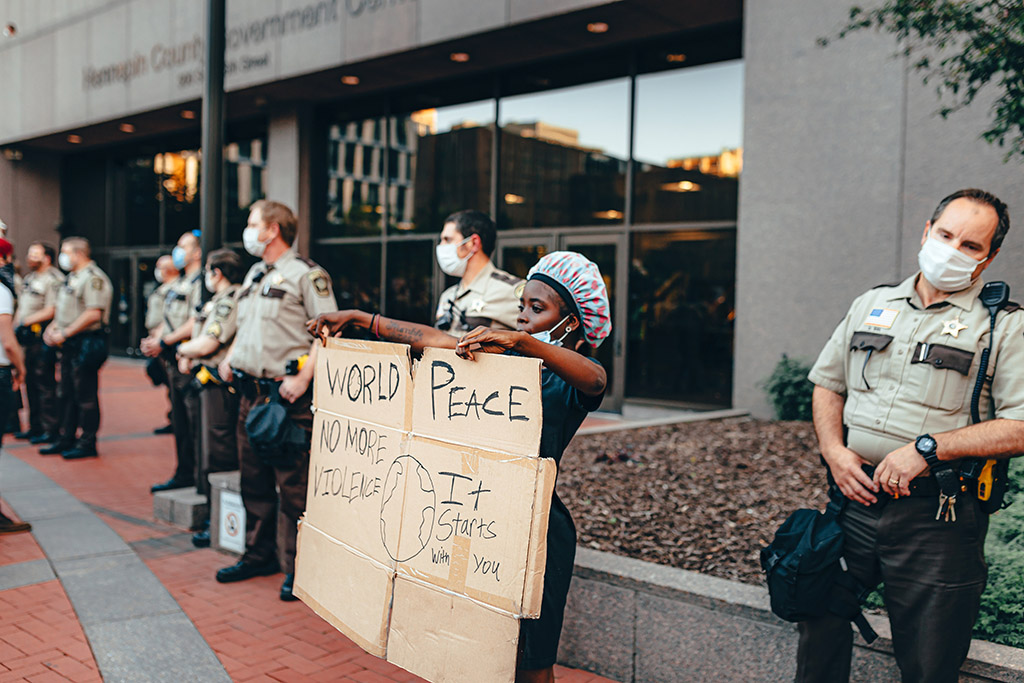
A lone protestor asserts herself before the watchful constabulary. Photo: Josh Hild
Colour-Blind
When it comes to skin colour, many are fortunately colour-blind. They do not perceive the world in binary shades of black or white, but rather—as the artist Frank Boeijen once so elegantly sang—in the colour of their heart.
There are also those who merely shrug; to them, racism appears as a phenomenon as old as time itself. Yet, this sentiment is not entirely accurate. The specific racism encountered by those of African descent is not as ancient as the world. Slavery—a concept often conflated with racism—certainly is. Not only the Egyptians, but the Romans and Greeks as well, employed enslaved persons for domestic labour and construction. Even for the marauding Vikings, this was a matter of daily existence; typically, it concerned captives seized during raids.43 In these instances, colour played no role; in principle, anyone could suffer such a fate.
Whether the tide of protest in the United States will ultimately culminate in a broader retreat of institutional racism remains to be seen.
It was not until the dawn of Early Modern Europe that a biological classification emerged, leading to the 'racialisation' of the world. The Transatlantic slave trade functioned as a pivotal link in this transformation. Tribal warfare and slave hunts within Africa resulted in hundreds of thousands of captives sold to overseas colonies. The majority were transported to the Americas, where a visible demarcation was drawn between the Black slave and the free white individual. Modern racism based on complexion was the grievous consequence. It should be noted that the indigenous peoples of the Americas—the Native Americans—also held slaves, though prior to the arrival of European colonists, these captives were not traded as commodities.

The shackles cast aside, yet the weight remains palpable. Photo: Lalesh Aldarwish
I Have a Dream
Despite the hard-won abolition of slavery in 1863, many of those formerly enslaved were compelled to continue their labour on plantations for another decade. This cessation of bondage by no means heralded the end of discrimination; a discrepancy arose because political and social equality was implemented primarily in theory, while remaining absent in practice. Thus it was that in 1963, Martin Luther King Jr. uttered those legendary words: "I have a dream." He envisioned a world where individuals would be judged not by their complexion, but by the content of their character. Fifty-seven years on, this ideal has yet to be universally realised. Many within the Black community continue to endure systemic disadvantage, perpetuated by the very architecture of the social order.44
Inevitably, there are those who maintain that the Black population bears sole responsibility for its own predicament. Yet, empirical research into the socio-economic position of Black individuals does not sustain such a thesis. Inquiries into recruitment practices reveal that, given equivalent qualifications, Black applicants are invited for follow-up interviews half as often as their white counterparts.45 Studies of the housing market illustrate a comparable disparity: Black home-seekers are forty per cent less likely to be granted a viewing.46
Beyond the private sector, profound inequities persist. Within the American judicial system—utilising algorithmic models to assess recidivism—Black defendants are twice as likely as white defendants to be erroneously classified as "high risk".47 This carries direct consequences for bail amounts and the duration of pre-trial detention. Collectively, these data constitute an unequivocal testament to the persistence of racism.
The Public Moral Interest
Whether the current tide of protest in the United States will ultimately culminate in a broader retreat of institutional racism remains uncertain. The responsibility now lies with the political establishment. As is widely acknowledged, within the political sphere, truth and reality do not always coincide. The abolition of slavery in 1863 was born less of pure altruism than of political and economic exigencies. Indeed, while slaveholders were handsomely compensated, the emancipated were left burdened by debt.
To dismiss America in its entirety as a racist nation—as is currently fashionable—is, however, a profound oversimplification. One must consider the countless American soldiers who have laid down their lives globally in the pursuit of liberty for others. Even our own freedom in the Netherlands, the liberty to speak our minds, is a legacy of that sacrifice. Furthermore, it remains a fact that nations such as Kenya, Tanzania, Uganda, Zambia, and Nigeria receive substantial economic aid from the United States.48 Such considerations ought not to be eclipsed in the heat of the discourse.
As a conviction, Black Lives Matter serves as a poignant reminder that racism has not been as thoroughly eradicated as we had presumed. One can only hope that this time—for political leaders across the globe—the public moral interest carries sufficient weight. Weight enough to finally, and irrevocably, turn the inky page of history that is racism.